concept functional interface in category java
This is an excerpt from Manning's book Modern Java in Action: Lambdas, streams, reactive and functional programming.
Where exactly can you use lambdas? You can use a lambda expression in the context of a functional interface. In the code shown here, you can pass a lambda as second argument to the method filter because it expects an object of type Predicate<T>, which is a functional interface. Don’t worry if this sounds abstract; we’ll now explain in detail what this means and what a functional interface is.
Remember the interface Predicate<T> you created in chapter 2 so you could parameterize the behavior of the filter method? It’s a functional interface! Why? Because Predicate specifies only one abstract method:
public interface Predicate<T> {
    boolean test (T t);
}
In a nutshell, a functional interface is an interface that specifies exactly one abstract method. You already know several other functional interfaces in the Java API such as Comparator and Runnable, which we explored in chapter 2:
We explained earlier that lambdas can be used only in the context of a functional interface. You need to create one that matches the signature BufferedReader -> String and that may throw an IOException. Let’s call this interface BufferedReaderProcessor:
This is an excerpt from Manning's book Java 8 in Action: Lambdas, streams, and functional-style programming.
So where exactly can you use lambdas? You can use a lambda expression in the context of a functional interface. In the code shown here, you can pass a lambda as second argument to the method filter because it expects a Predicate<T>, which is a functional interface. Don’t worry if this sounds abstract; we now explain in detail what this means and what a functional interface is.
Remember the interface Predicate<T> you created in chapter 2 so you could parameterize the behavior of the filter method? It’s a functional interface! Why? Because Predicate specifies only one abstract method:
public interface Predicate<T>{
    boolean test (T t);
}
In a nutshell, a functional interface is an interface that specifies exactly one abstract method. You already know several other functional interfaces in the Java API such as Comparator and Runnable, which we explored in chapter 2:
Java 8 brings a specialized version of the functional interfaces we described earlier in order to avoid autoboxing operations when the inputs or outputs are primitives. For example, in the following code, using an IntPredicate avoids a boxing operation of the value 1000, whereas using a Predicate<Integer> would box the argument 1000 to an Integer object:
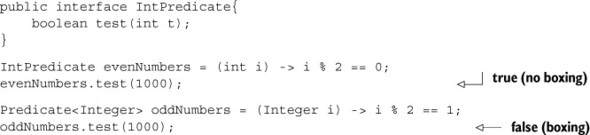
In general, the names of functional interfaces that have a specialization for the input type parameter are preceded by the appropriate primitive type, for example, DoublePredicate, IntConsumer, LongBinaryOperator, IntFunction, and so on. The Function interface has also variants for the output type parameter: ToIntFunction<T>, IntTo-DoubleFunction, and so on.
We explained earlier that lambdas can be used only in the context of a functional interface. You need to create one that matches the signature BufferedReader -> String and that may throw an IOException. Let’s call this interface BufferedReaderProcessor: