concept integration in category java

This is an excerpt from Manning's book JUnit in Action.
The integration platform usually runs the build process automatically to package and deploy the application; then it executes unit and functional tests. Functional testing means evaluating the compliance of a system or component with the requirements. This black-box testing type usually describes what the system does. Usually, only a subset of all functional tests is run on the integration platform, because compared with the target production platform, integration is a simple platform that lacks elements. (It may be missing a connection to an external system being accessed, for example.) All tests are executed on the integration platform. Time is less important, and the whole build can take several hours with no effect on development.
Introducing the software testing levels (unit, integration, system, and acceptance) and the concept of a test pyramid (from lower levels to higher ones)
This is an excerpt from Manning's book Java Testing with Spock.
This makes writing integration tests a lengthy process because about 80% of the code can be consumed by creating the test input for the class under test. Test input code generation is one of the first candidates for code reuse inside unit tests. In sufficiently large enterprise projects, test input generation might need a separate code module of its own, outside the production code.
Another big difference is the speed of tests. Unit tests (which depend only on Java code) are fast and give quick feedback. Integration and functional tests are much slower (especially when external systems and real databases are involved).

This is an excerpt from Manning's book Spring Integration in Action.
Enterprise Integration Patterns describes the patterns used in the exchange of messages, as well as the patterns that provide the glue between applications. Like the diagram in figure 1.1, it’s about messaging and integration in the broadest sense, and the patterns apply to both intra-application and inter application scenarios. Spring Integration supports the patterns described in the book, so we need to establish a broad understanding of the definitions of these patterns and the relations between them.

The two components of the Spring portfolio are complementary frameworks that can and should be used together for implementing a complete batch job–based enterprise integration solution. The integration between the two goes from simple, event-driven launching of batch jobs from Spring Integration to more sophisticated notification and automated feedback mechanisms using events published by Spring Batch and, even beyond that, to creating parallel and distributed batch jobs using Spring Integration as the underlying infrastructure.

This is an excerpt from Manning's book JUnit in Action, Second Edition.
These days, all major IDEs support integration with JUnit.
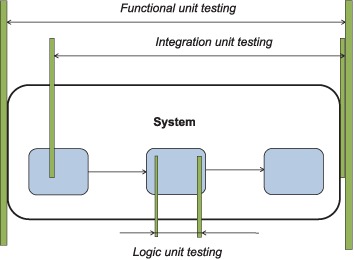
Test-driven development taught us to test early and test often. Executing all our unit, integration, and functional tests every time we make a small change would slow us immensely. To avoid this, we execute at development time only the unit tests—as early and as often as reasonable. What happens to the integration tests?
Here’s an interesting question: how often should you build your projects? This is a tough question, and it all depends on you and on the time you need to make a new build. It makes little sense to make a build every minute when you need more than a minute to execute the build itself. Keep in mind that this is a book about software testing, and we all propagate a lot of testing, using not only JUnit but also all kinds of integration and functional testing tools. This means that production builds tend to be time consuming.