concept internal iteration in category java
This is an excerpt from Manning's book Modern Java in Action: Lambdas, streams, reactive and functional programming.
Don’t worry about this code for now because it may look like a bit of magic. Chapters 4–7 are dedicated to explaining how to make sense of the Streams API. For now, it’s worth noticing that the Streams API provides a different way to process data in comparison to the Collections API. Using a collection, you’re managing the iteration process yourself. You need to iterate through the elements one by one using a for-each loop processing them in turn. We call this way of iterating over data external iteration. In contrast, using the Streams API, you don’t need to think in terms of loops. The data processing happens internally inside the library. We call this idea internal iteration. We come back to these ideas in chapter 4.
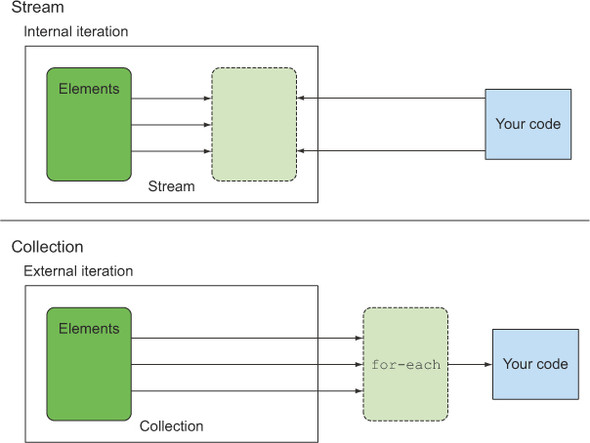
This is exactly what you do every day with your Java collections. You iterate a collection externally, explicitly pulling out and processing the items one by one. It would be far better if you could tell Sofia, “Put all the toys that are on the floor inside the box.” There are two other reasons why an internal iteration is preferable: first, Sofia could choose to take the doll with one hand and the ball with the other at the same time, and second, she could decide to take the objects closest to the box first and then the others. In the same way, using an internal iteration, the processing of items could be transparently done in parallel or in a different order that may be more optimized. These optimizations are difficult if you iterate the collection externally as you’re used to doing in Java. This may seem like nit-picking, but it’s much of the raison-d’être of Java 8’s introduction of streams. The internal iteration in the Streams library can automatically choose a data representation and implementation of parallelism to match your hardware. By contrast, once you’ve chosen external iteration by writing for-each, then you’ve committed to self-manage any parallelism. (Self-managing in practice means either “one fine day we’ll parallelize this” or “starting the long and arduous battle involving tasks and synchronized.”) Java 8 needed an interface like Collection but without iterators, ergo Stream! Figure 4.4 illustrates the difference between a stream (internal iteration) and a collection (external iteration).
We’ve described the conceptual differences between collections and streams. Specifically, streams make use of internal iteration, where a library takes care of iterating for you. But this is useful only if you have a list of predefined operations to work with (for example, filter or map) that hide the iteration. Most of these operations take lambda expressions as arguments so you can parameterize their behavior as we showed in the previous chapter. The Java language designers shipped the Streams API with an extensive list of operations you can use to express complicated data processing queries. We’ll briefly look at this list of operations now and explore them in more detail with examples in the next chapter. To check your understanding of external versus internal iteration, try quiz 4.1 below.
This is an excerpt from Manning's book Java 8 in Action: Lambdas, streams, and functional-style programming.
Don’t worry about this code for now because it may look like a bit of magic. Chapters 4–7 are dedicated to explaining how to make sense of the Streams API. For now it’s worth noticing that the Streams API provides a very different way to process data in comparison to the Collections API. Using a collection, you’re managing the iteration process yourself. You need to iterate through each element one by one using a for-each loop and then process the elements. We call this way of iterating over data external iteration. In contrast, using the Streams API, you don’t need to think in terms of loops at all. The data processing happens internally inside the library. We call this idea internal iteration. We come back to these ideas in chapter 4.
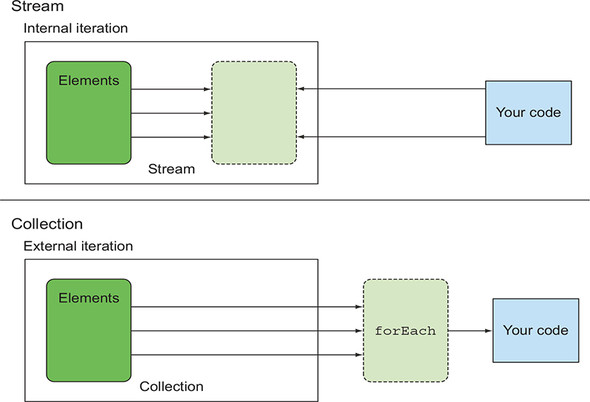
This is exactly what you do every day with your Java collections. You iterate a collection externally, explicitly pulling out and processing the items one by one. It would be far better if you could just tell Sofia, “Put all the toys that are on the floor inside the box.” There are two other reasons why an internal iteration is preferable: first, Sofia could choose to take at the same time the doll with one hand and the ball with the other, and second, she could decide to take the objects closest to the box first and then the others. In the same way, using an internal iteration, the processing of items could be transparently done in parallel or in a different order that may be more optimized. These optimizations are difficult if you iterate the collection externally as you’re used to doing in Java. This may seem like nit-picking, but it’s much of the raison-d’être of Java 8’s introduction of streams—the internal iteration in the Streams library can automatically choose a data representation and implementation of parallelism to match your hardware. By contrast, once you’ve chosen external iteration by writing for-each, then you’ve essentially committed to self-manage any parallelism. (Self-managing in practice means either “one fine day we’ll parallelize this” or “starting the long and arduous battle involving tasks and synchronized”.) Java 8 needed an interface like Collection but without iterators, ergo Stream! Figure 4.4 illustrates the difference between a stream (internal iteration) and a collection (external iteration).
We’ve described the conceptual differences between collections and streams. Specifically, streams make use of internal iteration: iteration is taken care of for you. But this is useful only if you have a list of predefined operations to work with (for example, filter or map) that hide the iteration. Most of these operations take lambda expressions as arguments so you can parameterize their behavior as we showed in the previous chapter. The Java language designers shipped the Streams API with an extensive list of operations you can use to express complicated data processing queries. We’ll briefly look at this list of operations now and explore them in more detail with examples in the next chapter.