concept node in category java

This is an excerpt from Manning's book Griffon in Action.
You’ve introduced a number of nodes for this particular view. The particulars for working with nodes and views will be discussed in chapter 4. Now, whenever the text in the text area doesn’t match the text in the model, the dirty boolean’s value switches, which enables or disables the Save button.
As you know, SwingBuilder relies on node factories to manipulate and instantiate nodes. You may register as many node factories on a view script as needed. The advantages of registering a node factory are as follows:

This is an excerpt from Manning's book JavaFX in Action.
The elements of the scene graph are known as nodes. Some nodes describe drawing primitives, such as a rectangle, a circle, a bitmap image, or a video clip. Other nodes act as grouping devices; like directories in a filesystem, they enable other nodes to be collected together and a treelike structure to be created. This treelike structure is important for deciding how the nodes appear when they overlap, specifically which nodes appear in front of other nodes and how they are related to one another when manipulated. We can best demonstrate this functionality using figure 5.2.
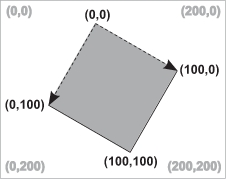
Each scene graph node has a way of specifying its location within its own local space; for example, Rectangle has x and y, Circle has centerX and centerY, and so on. These define points within the node’s own local coordinate space, quite separate to (although ultimately combined with) its location as a whole (see figure 5.13).