concept practice in category java
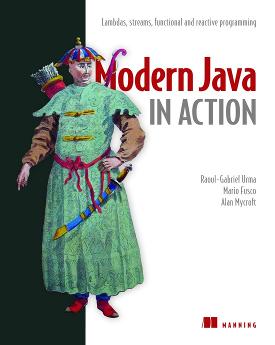
This is an excerpt from Manning's book Modern Java in Action: Lambdas, streams, reactive and functional programming.
You’ve now seen that behavior parameterization is a useful pattern to easily adapt to changing requirements. This pattern lets you encapsulate a behavior (a piece of code) and parameterize the behavior of methods by passing and using these behaviors you create (for example, different predicates for an Apple). We mentioned earlier that this approach is similar to the strategy design pattern. You may have already used this pattern in practice. Many methods in the Java API can be parameterized with different behaviors. These methods are often used together with anonymous classes. We show four examples, which should solidify the idea of passing code for you: sorting with a Comparator, executing a block of code with Runnable, returning a result from a task using Callable, and GUI event handling.
But you saw that using anonymous classes to represent different behaviors is unsatisfying. It’s verbose, which doesn’t encourage programmers to use behavior parameterization in practice. In this chapter, we’ll teach you about a new feature in Java 8 that tackles this problem: lambda expressions. They let you represent a behavior or pass code in a concise way. For now you can think of lambda expressions as anonymous functions, methods without declared names, but which can also be passed as arguments to a method as you can with an anonymous class.
Let’s look at an example of how lambdas, together with behavior parameterization, can be used in practice to make your code more flexible and concise. A recurrent pattern in resource processing (for example, dealing with files or databases) is to open a resource, do some processing on it, and then close the resource. The setup and cleanup phases are always similar and surround the important code doing the processing. This is called the execute-around pattern, as illustrated in figure 3.2. For example, in the following code, the highlighted lines show the boilerplate code required to read one line from a file (note also that you use Java 7’s try-with-resources statement, which already simplifies the code, because you don’t have to close the resource explicitly):
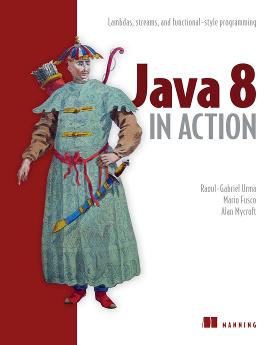
This is an excerpt from Manning's book Java 8 in Action: Lambdas, streams, and functional-style programming.
You’ve now seen that behavior parameterization is a useful pattern to easily adapt to changing requirements. This pattern lets you encapsulate a behavior (a piece of code) and parameterize the behavior of methods by passing and using these behaviors you create (for example, different predicates for an Apple). We mentioned earlier that this approach is similar to the strategy design pattern. You may have already used this pattern in practice. Many methods in the Java API can be parameterized with different behaviors. These methods are often used together with anonymous classes. We show three examples, which should solidify the idea of passing code for you: sorting with a Comparator, executing a block of code with Runnable, and GUI event handling.
But you saw that using anonymous classes to represent different behaviors is unsatisfying: it’s verbose, which doesn’t encourage programmers to use behavior parameterization in practice. In this chapter, we teach you about a new feature in Java 8 that tackles this problem: lambda expressions, which let you represent a behavior or pass code in a concise way. For now you can think of lambda expressions as anonymous functions, basically methods without declared names, but which can also be passed as arguments to a method as you can with an anonymous class.
Let’s look at an example of how lambdas, together with behavior parameterization, can be used in practice to make your code more flexible and concise. A recurrent pattern in resource processing (for example, dealing with files or databases) is to open a resource, do some processing on it, and then close the resource. The setup and cleanup phases are always similar and surround the important code doing the processing. This is called the execute around pattern, as illustrated in figure 3.2. For example, in the following code, the highlighted lines show the boilerplate code required to read one line from a file (note also that you use Java 7’s try-with-resources statement, which already simplifies the code, because you don’t have to close the resource explicitly):