concept responsibility in category java

This is an excerpt from Manning's book Spring Integration in Action.
This is the first step down the road of IoC. The factory handles the responsibility that was previously handled directly in the caller’s code. The control is inverted in favor of a factory. The caller gladly relinquishes that control in return for having to make fewer assumptions about the implementation it’s using. This seems to solve the problem at first, but to some degree it’s just pushing the problem one step further away. It’s the programmatic equivalent of sweeping dirt under the rug.

This is an excerpt from Manning's book AspectJ in Action, Second Edition.
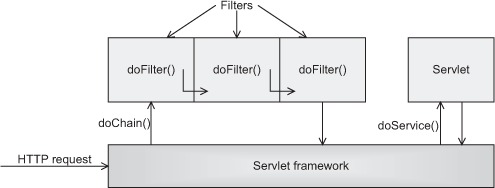
Design patterns also provide solutions to crosscutting concerns. In this section, we’ll take a comparative look at some of the design patterns—observer, chain of responsibility, decorator, proxy, and interceptor—that help with crosscutting concerns. You’ll see that quite a few similarities exist between design patterns and AOP—you can view a few design patterns as a “poor man’s” AOP implementation.