concept server side in category java

This is an excerpt from Manning's book Flex on Java.
In 1995, Sun introduced the first Java platform and gave birth to the applet which allowed Java applications to run inside the browser with rich functionality and all the benefits of the Java framework, including connecting to the server side. The applet became hugely popular for a couple of years before its popularity waned mainly because of problems surrounding the browser plugin.
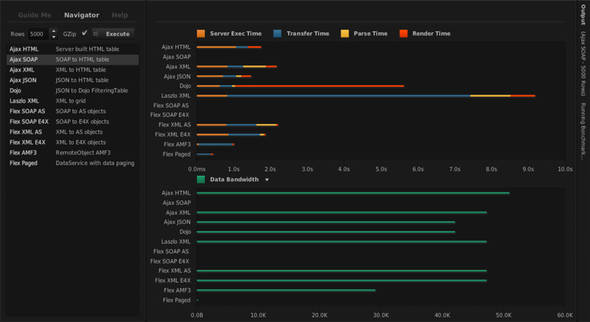
For Action Message Format communication, or AMF, Flex provides the RemoteObject component that uses Adobe’s own AMF binary protocol to communicate with the server. This means you’ll need a process running on the server side, such as BlazeDS, that understands how to serialize and deserialize the AMF protocol.
You may be asking, “Why would I use BlazeDS instead of web services?” One of the biggest advantages to using the AMF protocol for communication is performance. Adobe’s James Ward put together a nice application called BlazeBench (http://www.jamesward.com/wordpress/2007/12/12/blazebench-why-you-want-amf-and-blazeds/), which benchmarks methods of communicating to the server side from a web application, including Flex, and displays the different aspects of the transaction. Figure 5.2 shows a sample output from BlazeBench.

This is an excerpt from Manning's book GWT in Practice.
As the world of web applications began to expand, developers supporting the basic form applications on the server side repurposed the Model View Controller (MVC) pattern so that it centered on the server and rendered to HTML. From simple Perl scripts to complete frameworks, development remained on the server, and things like application state became a complex problem with complex solutions���involving everything from Struts to JavaServer Faces (JSF) and Seam. Although these solutions made web applications more capable and development easier, they didn���t provide the user experience of a full desktop-like fat client application, and they continued in the same render-call-render lifecycle that the web had used when forms were first added.
When Netscape introduced JavaScript to the web browser, the browser became something more than just a simple thin client. It became a platform on its own, capable of running small applications entirely within the scope of a page. This approach was widely used for simple things, such as field validation, but its use didn���t spread to more advanced functionality until Microsoft introduced the XMLHttpRequest (XHR) object. This object made calls back to the server from the JavaScript environment easy, and the technique was soon adopted by all the major browsers. The frontiers and capabilities of web applications expanded even further when dynamic HTML and forms were combined with the server side via XHR, permitting only portions of browser windows to be redrawn. The Ajax era was born.