concept tree in category java
This is an excerpt from Manning's book Modern Java in Action: Lambdas, streams, reactive and functional programming.
In Java, you would write an if-then-else or a switch statement. Other languages have shown that, for more complex data types, pattern matching can express programming ideas more concisely compared to using if-then-else. For such data types, you might also use polymorphism and method overriding as an alternative to if-then-else, but there’s ongoing language-design discussion as to which is more appropriate.[9] We’d say that both are useful tools and that you should have both in your armory. Unfortunately, Java 8 doesn’t have full support for pattern matching, although we show how it can be expressed in chapter 19. A Java Enhancement Proposal is also being discussed to support pattern matching in a future version of Java (see http://openjdk.java.net/jeps/305). In the meantime, let’s illustrate with an example expressed in the Scala programming language (another Java-like language using the JVM that has inspired some aspects of Java evolution; see chapter 20). Suppose you want to write a program that does basic simplifications on a tree representing an arithmetic expression. Given a data type Expr representing such expressions, in Scala you can write the following code to decompose an Expr into its parts and then return another Expr:
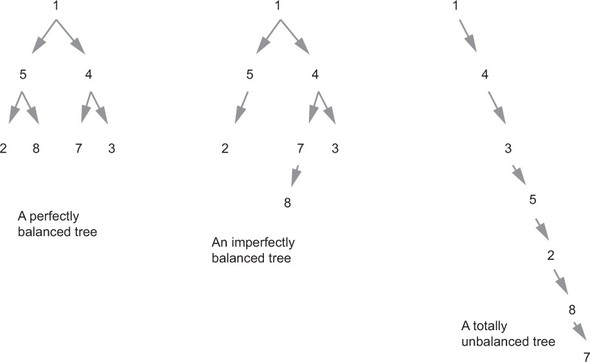
In general, this code isn’t expensive. If the tree is of depth d and reasonably well balanced, it can have around 2d entries, so you re-create a small fraction of it.
class Tree {
   private String key;
   private int val;
   private Tree left, right;
   public Tree(String k, int v, Tree l, Tree r) {
     key = k; val = v; left = l; right = r;
   }
}
class TreeProcessor {
    public static int lookup(String k, int defaultval, Tree t) {
        if (t == null) return defaultval;
        if (k.equals(t.key)) return t.val;
        return lookup(k, defaultval,
                         k.compareTo(t.key) < 0 ? t.left : t.right);
    }
    // other methods processing a Tree
}
This is an excerpt from Manning's book Functional Programming in Java: How functional techniques improve your Java programs.
Graphs are collections in which each element is in relationships with multiple other elements. A particular example is the tree, and more specifically the binary tree, where each element is related to two other elements. You’ll learn more about trees from a functional perspective in chapter 10.
The tree represented in figure 10.1 isn’t very common because its elements are of different types. In other words, it’s a tree of objects. Most often, you’ll deal with trees of a more specific type, such as trees of integers. In the figure, you can see that a tree is a recursive structure. Each branch leads to a new tree (sometimes called a subtree). You can also see that some branches lead to a single element. This isn’t a problem, because a single element is in fact a tree with empty branches. Also note the T element: it has a left branch, but no right one.
This is an excerpt from Manning's book Java 8 in Action: Lambdas, streams, and functional-style programming.
In Java you would here write an if-then-else or a switch statement. Other languages have shown that, for more complex data types, pattern matching can express programming ideas more concisely compared to using if-then-else. For such data types, you might also use polymorphism and method overriding as an alternative to if-then-else, but there’s still language-design discussion as to which is more appropriate.[9] We’d say that both are useful tools and you should have both in your armory. Unfortunately, Java 8 doesn’t have full support for pattern matching, although we show how it can be expressed in chapter 14. In the meantime, we illustrate with an example expressed in the Scala programming language (another Java-like language using the JVM that has inspired some aspects of Java evolution; see chapter 15). Suppose you want to write a program that does basic simplifications on a tree representing an arithmetic expression. Given a data type Expr representing such expressions, in Scala you can write the following code to decompose an Expr into its parts and then return another Expr:
class Tree {
   private String key;
   private int val;
   private Tree left, right;
   public Tree(String k, int v, Tree l, Tree r) {
     key = k; val = v; left = l; right = r;
   }
}

class TreeProcessor {
    public static int lookup(String k, int defaultval, Tree t) {
        if (t == null) return defaultval;
        if (k.equals(t.key)) return t.val;
        return lookup(k, defaultval,
                         k.compareTo(t.key) < 0 ? t.left : t.right);
    }
    // other methods processing a Tree
}