concept composition in category javascript

This is an excerpt from Manning's book The Joy of JavaScript.
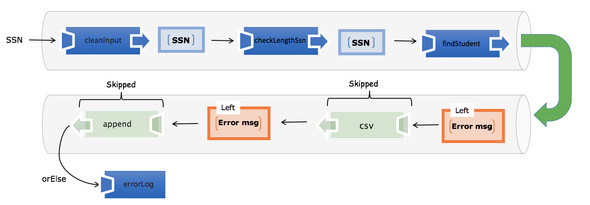
As you can see in the example above, arguments (filename) represent the initial condition of the program and are sent to the first (rightmost) function (read). Then the output of that function becomes the input to next and so on, accumulated all the way through. So, marrying the maths with programming, composition is nothing more than a right-to-left reduction of functions. Figure 1.9 shows the flow of execution of countBlocksInFile:
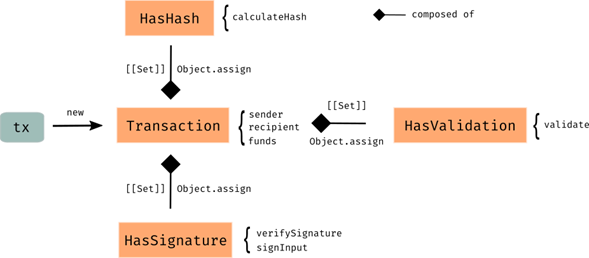
Figure 3.5 When using composition, the mechanism by which an object is built consists of gluing together other independent objects: HasHash, HasSignature, and HasValidation. The properties of each one will get mashed up into a single source forming a single object from the user’s point of view. One noticeable difference is that by composing mixins together, object graphs collapse to a single level, instead of multiple (linked) levels.
This is an excerpt from Manning's book Functional Programming in JavaScript.
All along, I’ve been using run to combine functions to make up whole programs. It’s time to uncover this dark magic. In reality, run is an alias for one of the most important techniques: composition. The composition of two functions is another function that results from taking the output of one and plugging it into the next. Assume that you have two functions f and g. Formally, this can be expressed as follows:
They must be composable. This property indicates that the composition of a function applied to fmap should be exactly the same as chaining fmap functions together. As a result, the following expression is exactly equivalent to the program in listing 5.2: two.fmap(R.compose(plus3, R.tap(infoLogger))).map(R.identity); //-> 5