concept object in category javascript
This is an excerpt from Manning's book The Joy of JavaScript.
Figure 1.6 On the left: the inheritance hierarchy reuses attributes from parent classes to define what a child “IS.” This is called an IS-A relationship denoted by an arrow to mean something looks like something else. On the right: by composing objects with their own independent behavior and attributes you define what something “HAS,” also known as a “HAS-A” relationship denoted by a diamond, to mean what something uses something else.

This code snippet is short but packs in a lot of interesting concepts. The object returned by perfCountHandler is the proxy handler. get receives two arguments: target is the object being intercepted and key is the name of the property being called. The logic checks whether the property being invoked is of interest to us, and if it is, I use Reflect to invoke said property (reflectively) on the target object surrounded by time measurements. Otherwise, I skip this logic and, similarly, call the target object.
The first technique, made popular by Kyle Simpson, relies on prototype or behavior delegation. Prototype delegation is the more proper term when talking about inheritance. In essence, it allows an object to delegate behavior to its prototype, which is simply just another object linked internally via the prototype chain. The two important components of this technique are composition and delegation. Unlike classes, prototype delegation leverages JavaScript’s native constructs like Object.create, but helps strip away some of pseudo-classical programming features that clutter up your code.
The second approach is based on composing simple objects known as mixins, which you can see in full display in the works of Eric Elliot, Douglas Crockford, and other community leaders. In this case, instead of sharing common functionality from a common prototype, mixins allow you integrate various independent objects to form a single one. You can think of attaching a mixin to an object as like attaching a body part or a weapon to a knight’s chain mail vest.
As mentioned earlier, delegation that leverages [[Prototype]] is implicit and JavaScript’s property lookup mechanism embodies this exactly when you query properties of an object not directly defined on that object itself but found higher up in the chain. Let’s now unpack our previous OLOO snippet:
const MyArray = {
   init(element) {
      this.length = 0
      this.push(element)
      return this
   },
   push(b) {
      this[this.length] = b
      return ++this.length
   }
}
const Blockchain = Object.create(MyArray)

const chain = Object.create(Blockchain).init(createGenesisBlock())
In the definition of MyArray, the init method has two roles. It acts like a typical object constructor in that it sets the properties of the new instance, but at the same time it behaves like a factory function because it returns the new object back to the caller. Afterwards, the first call to Object.create joins MyArray to Blockchain. The second call, is what creates new instances of blockchain. At this point all of the links are in place and Blockchain knows about init and push, but the objects have no data. The twist I referred to earlier is that instantiation happens by calling init, which sets everything in motion, populates the first block in the chain, and returns a ready-to-use object to the caller.
This is an excerpt from Manning's book Get Programming with JavaScript Next: New features of ECMAScript 2015, 2016, and beyond.
ECMAScript Sixth Edition was finalized in June of 2015. The Sixth Edition was the first major update to the language in over 15 years. The landscape of the web and the way websites and web applications were built had changed drastically, so naturally there were many new ideas, leading to new syntax, operators, primitives, and objects with enhancements to existing ones, as well as a treasure trove of new concepts. All of this equates to the Sixth Edition being a major revision.
Know how to extend objects with Object.assign
Now you’ve created an enhancedSpaceShip function that takes an object of enhancements as an argument. These enhancements could be new features or could override existing features. Notice how in every example so far, you’ve created an object and then mutated it? Sometimes that’s desired, but often you just want a copy.

This is an excerpt from Manning's book Secrets of the JavaScript Ninja, Second Edition.
JavaScript consists of a close relationship between objects and prototypes, and functions and closures. Understanding the strong relationships between these concepts can vastly improve your JavaScript programming ability, giving you a strong foundation for any type of application development, regardless of whether your JavaScript code will be executed in a web page, in a desktop app, in a mobile app, or on the server.
Listing 3.2. Storing a collection of unique functions
var store = { nextId: 1, #A cache: {}, #B add: function(fn) { #C if (!fn.id) { #C fn.id = this.nextId++; #C this.cache[fn.id] = fn; #C return true; #C } #C } #C }; function ninja(){} assert(store.add(ninja), #D "Function was safely added."); #D assert(!store.add(ninja), #D "But it was only added once."); #D #A - Keeps track of the next available ID to be assigned #B - Creates an object to serve as a cache in which we’ll store functions #C - Adds functions to the cache, but only if they’re unique #D - Tests that all works as planned !@%STYLE%@! {"css":"{\"css\": \"font-weight: bold;\"}","target":"[]"} !@%STYLE%@!
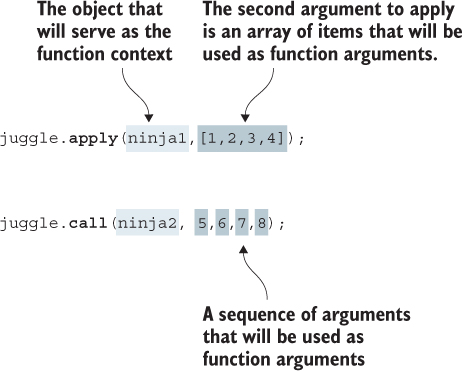
Figure 4.3. As the first argument, both the call and apply methods take the object that will be used as the function context. The difference is in the following arguments. apply takes only one additional argument, an array of argument values; call takes any number of arguments, which will be used as function arguments.
How do you test whether an object has access to a particular property?
In JavaScript, objects are collections of named properties with values. For example, we can easily create new objects with object-literal notation:
This is an excerpt from Manning's book Functional Programming in JavaScript.
To talk more concretely about these issues, suppose you’re a developer on a team implementing an application to manage a school’s student data. Listing 1.3 shows a small imperative program that finds a student record by Social Security number and renders it in the browser (again, the use of the browser is immaterial; you could just as easily write to the console, a database, or a file). I refer to and expand this program throughout the book as a typical, real-world scenario that involves side effects by interacting with an external local object store (like an array of objects) and doing some level of IO.
Despite its C-like syntax, JavaScript draws lots of inspiration from functional languages like Lisp and Scheme. Their commonalities lie in their support for higher-order functions, closures, array literals, and other features that make JavaScript a superb platform for applying FP techniques. In fact, functions are the main units of work in JavaScript, which means they’re used not only to drive the behavior of your applications, but also to define objects, create modules, and handle events.
Alternatively, functional programming removes the need to hide data from the callers and typically works with a smaller set of very simple data types. Because everything is immutable, you’re free to work with objects directly, but this time through generalized functions that live outside of an object’s scope. In other words, data is loosely coupled to behavior. As you can see in figure 2.1, instead of fine-grained instance methods, functional code relies on more coarse-grained operations that can crosscut or work across many data types. In this paradigm, functions become the main form of abstraction.
Figure 2.1. Object-oriented programming promotes logically connecting many data types with specialized behavior, whereas functional programming focuses on connecting operations on those data types via composition. There’s a sweet spot where both paradigms can be used productively. Hybrid languages like Scala, F#, and JavaScript allow you to work with both.
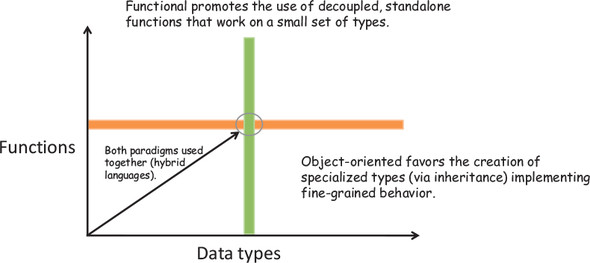
Looking at figure 2.1, you see the two paradigms differ as you move up and to the right. In practice, some of the best object-oriented code I’ve seen uses both paradigms together—at their intersection. To do this, you need to treat objects as immutable entities or values and separate their functionality into functions that work on these objects. So a method on Person that looks like this
Function.prototype.apply(thisArg, [argsArray])

Function.prototype.call(thisArg, arg1,arg2,...)
Strings and numbers are probably the easiest data types to work with in any programming language. Why do you think that is? Part of the reason is that, traditionally, these primitive types are inherently immutable, which gives us a certain peace of mind that other user-defined types don’t. In functional programming, we call types that behave this way values. In chapter 1, you learned to think about immutability, and this requires effectively treating any object as a value; doing so allows you to work with functions that pass objects around and not worry about them being altered.
Despite all the syntactic sugar added around classes in ES6, JavaScript objects are nothing more than bags of attributes that can be added, removed, and changed at any time. What can you do to remedy this? Many programming languages support constructs that make an object’s properties immutable. One example is Java’s final keyword. Also, languages like F# have immutable variables by default, unless stated otherwise. At present, you don’t have this luxury in JavaScript. Although JavaScript primitive types can’t be changed, the state of the variable that refers to a primitive type can. Therefore, you need to be able to provide, or at least emulate, immutable references to data so that your user-defined objects behave as if they were immutable.
This is an excerpt from Manning's book Node.js in Practice.
Streams inherit from EventEmitter and can be used to model data with unpredictable throughput—like a network connection where data speeds can vary depending on what other users on the network are doing. Using Node’s stream API allows you to create an object that receives events about the connection: data for when new data comes in, end when there’s no more data, and error when errors occur.
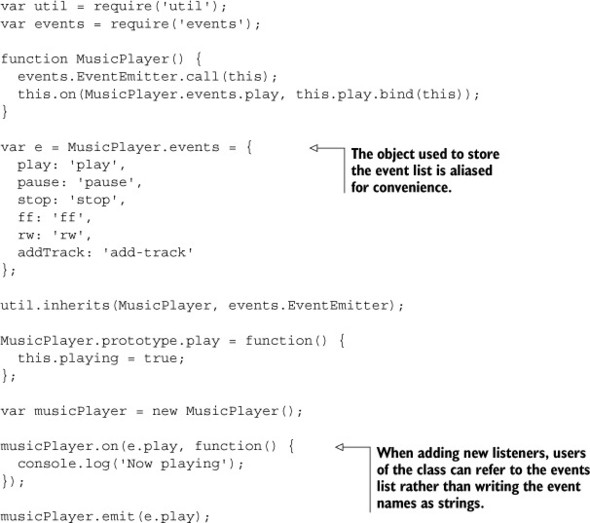
The easiest way to solve this problem is to use an object to act as a central dictionary for all of the event names. This creates a centralized location of each event in the project.
It’s hard to keep track of event names littered throughout a project. One way to manage this is to keep each event name in one place. Listing 4.14 demonstrates using an object to categorize event names, based on the previous examples in this chapter.
events.js:72
  throw er; // Unhandled 'error' event
 ^
Error: No handler to catch me
  at Object.<anonymous> (/debugging/domain/ee.js:5:18)
  at Module._compile (module.js:456:26)
  at Object.Module._extensions..js (module.js:474:10)
  at Module.load (module.js:356:32)
  at Function.Module._load (module.js:312:12)
  at Function.Module.runMain (module.js:497:10)
  at startup (node.js:119:16)
  at node.js:902:3

This is an excerpt from Manning's book Prototype and Scriptaculous in Action.
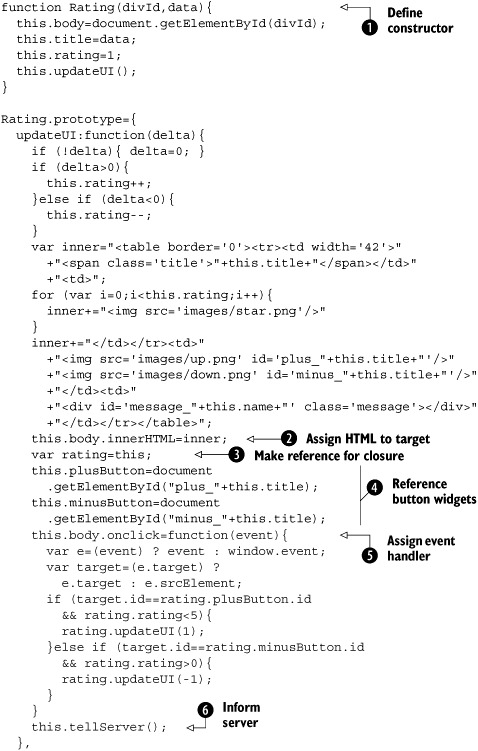
JavaScript is a general-purpose programming language. As an Ajax developer, you’ll generally be using Prototype inside a web browser, but certain parts of it, such as objects, features, arrays, strings, and numbers, are designed to enhance the JavaScript language itself.
Here in part 3 of the book, we’ll be manipulating and generating lots of values, objects, and arrays. We’ve therefore written a simple helper method that displays a value graphically in the output area. The function signature is as follows:
Most modern programming languages that support objects support reflection. Reflection is the process of examining an object to find out what properties and methods it contains. In strictly typed object-oriented languages, such as Java and C#, one usually knows what types of objects one is dealing with, and reflection is a relatively esoteric business. In loosely typed languages, such as JavaScript, the need for reflection is perhaps more common. We present the mechanism here for two reasons. First, to illustrate how simple it is in JavaScript. And second, to set the scene for some of the design decisions that Prototype has taken in the way it handles objects.
There are generally two stages to reflecting on an object: iterating over the members of the object—all of its properties and methods—and then querying the individual properties and methods to find out what type they are.
Note the use of the array-like syntax to reference properties of the object.
The good news is that the second step is easy too. JavaScript provides an instanceof operator that can tell us the type of an object—whether it is an Array, a String, an Object, or a user-defined type.
Our Scratchpad application uses simple JavaScript reflection to work out what to do with objects passed to the show() function. First, it determines what type of object it is dealing with, limiting the categories to Array, Object, or anything else:
function show(title,obj){
  if (obj instanceof Array){
    showList(title,obj);
  }else if (obj instanceof Object){
    showObj(title,obj);
  }else{
    showVal(title,obj);
  }
}
Note that we test for Arrays before Objects. Arrays are a subclass of Object, so instanceof Object will return true for any JavaScript object.
When rendering an object using the showObj() function, we make use of the for...in loop to iterate through the members and list them all out: