concept cadence in category kanban

This is an excerpt from Manning's book Kanban in Action.
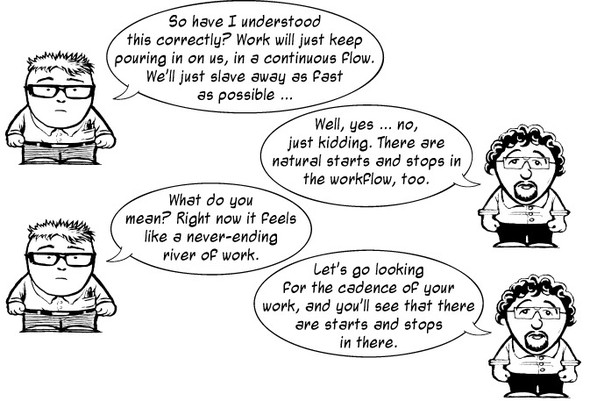
A cadence gives you a foundation for predictability. With a regular cadence, you can start to measure and predict how you’re doing against a goal. You could say that your goal is to deliver four to six work items every other week. When two weeks have passed, you can look back and see how you did against your goal. The two weeks’ cadence you now have introduced is for review purposes.
Timeboxed iterations like the ones we described previously are only one kind of cadence. Cadences can take many forms, and in this section we’ll examine different ways that they can manifest themselves in kanban and the gain you can get from using them.
An iteration typically starts with some sort of planning or assessment of what you’re getting ready to do; you do it, and then you’re done—preferably you end by looking back on what you’ve done during the last iteration and seeing if you can improve. The cadence for the sprint is, for example, two weeks, and a new “heartbeat” in your process is started when the next iteration begins.