concept room in category Keras
This is an excerpt from Manning's book Probabilistic Deep Learning: With Python, Keras and TensorFlow Probability.
You’ll see in this chapter that traditional non-Bayesian models don’t express their uncertainties if they are trained with few data or used for extrapolation, but Bayesian models do. Therefore, it’s better to use Bayesian approaches when you have little training data, or when you can’t rule out that you’ll encounter situations not seen in training - like an elephant in a room (see figure above). You will see, that even state-of-the-art DL models that were winning the ImageNet challenge and are usually great in classifying elephants, are not able to classify an elephant in a room correctly. Instead, a wrong class is predicted, often with a high probability. This inability to communicate the fact, that they have a problem with new situations and so produce unreliable predictions, are a serious deficit of non-Bayesian DL models. Bayesian DL models, on the other hand, have the ability to express their uncertainty.
Figure 7.2 Bad case of DL. The high performant VGG16-CNN trained on ImageNet data fails to see the elephant in the room. The five highest-ranked class predictions of the objects in the image are horse_cart, shopping_cart, palace, streetcar, gondola; the elephant is not found! This image is an extrapolation of the training set. In the regression problem on the right side of the dashed vertical line, there’s zero uncertainty in the regions where there’s no data (extrapolation).
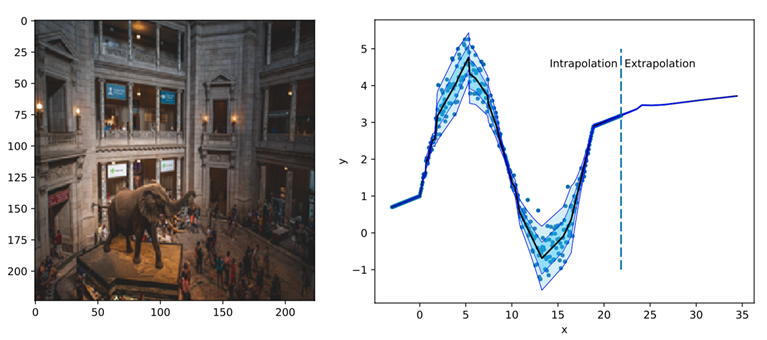
Even if we only hope to exploit the statistical correlations in DL, we have a severe problem: the network doesn’t tell us that it has a problem with the elephant in the room. It doesn’t know when it doesn’t know. It simply assigns it to the wrong class, sometimes even with a high probability. Now, imagine yourself sitting in a self-driving car. Do you feel comfortable?