concept microservice in category kubernetes

This is an excerpt from Manning's book Kubernetes in Action, Second Edition.
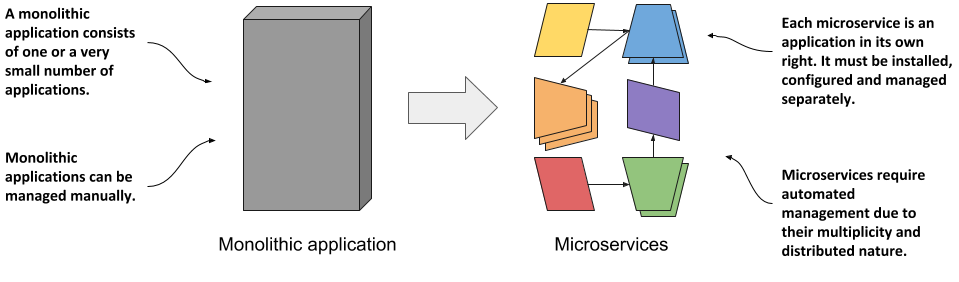
Then came the microservices paradigm. The monoliths were divided into dozens, sometimes hundreds, of separate processes, as shown in the following figure. This allowed organizations to divide their development departments into smaller teams where each team developed only a part of the entire system - just some of the microservices.
Figure 1.6 Comparing monolithic applications with microservices
This is an excerpt from Manning's book Kubernetes in Action.
Microservices communicate through synchronous protocols such as HTTP, over which they usually expose RESTful (REpresentational State Transfer) APIs, or through asynchronous protocols such as AMQP (Advanced Message Queueing Protocol). These protocols are simple, well understood by most developers, and not tied to any specific programming language. Each microservice can be written in the language that’s most appropriate for implementing that specific microservice.