concept virtual machine in category kubernetes

This is an excerpt from Manning's book Kubernetes in Action, Second Edition.
Kubernetes can run directly on your bare-metal machines or in virtual machines running in your data center. In either case, you won’t be able to scale your cluster as easily as when you run it in virtual machines provided by a cloud provider.
2.1.1 Comparing containers to virtual machines
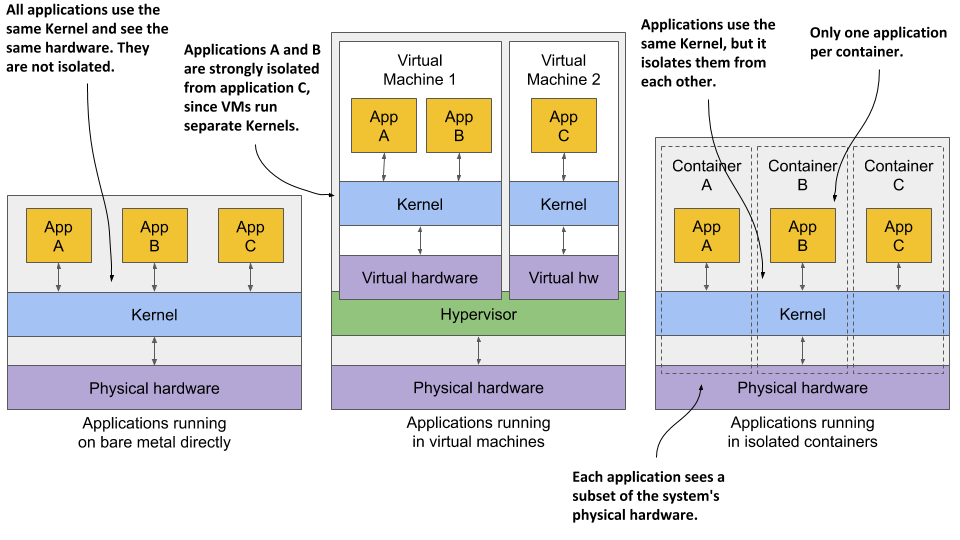
Instead of using virtual machines to isolate the environments of individual microservices (or software processes in general), most development and operations teams now prefer to use containers. They allow you to run multiple services on the same host computer, while keeping them isolated from each other. Like VMs, but with much less overhead.
Unlike VMs, which each run a separate operating system with several system processes, a process running in a container runs within the existing host operating system. Because there is only one operating system, no duplicate system processes exist. Although all the application processes run in the same operating system, their environments are isolated, though not as well as when you run them in separate VMs. To the process in the container, this isolation makes it look like no other processes exist on the computer. You’ll learn how this is possible in the next few sections, but first let’s dive deeper into the differences between containers and virtual machines.
Figure 2.3 The difference between running applications on bare metal, in virtual machines, and in containers
This is an excerpt from Manning's book Kubernetes in Action.
Instead of using virtual machines to isolate the environments of each microservice (or software processes in general), developers are turning to Linux container technologies. They allow you to run multiple services on the same host machine, while not only exposing a different environment to each of them, but also isolating them from each other, similarly to VMs, but with much less overhead.