concept information in category lift

This is an excerpt from Manning's book Lift in Action: The Simply Functional Web Framework for Scala.
Working from the root folder through the project tree, you should see the project directory. This is where SBT holds the information about the application, dependencies, and repositories. You configure the build environment with Scala code, which is fully type-safe, and SBT won’t let you proceed if your Project.scala won’t compile. The basic project file for the example application should look something like the next listing.
The HTTPRequest instance that represents the incoming request. This can be used when you want to extract information from the request that the default matchers don’t allow for.
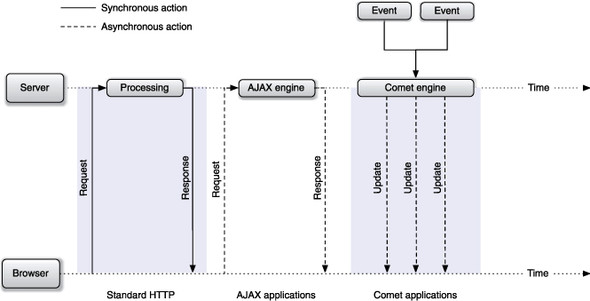
Actors send and receive information as messages, and this happens to be a very nice fit with the request and response cycle present in HTTP. To this end, Lift provides an abstraction for Comet programming called CometActor. Figure 4.2 illustrates how Comet-orientated applications typically differ from traditional request and response workflows. Compared to both standard HTTP calls and AJAX calls, Comet doesn’t require a request to have a matched response. Once the page has been rendered and Lift has an appropriate CometActor in the current session, said CometActor can arbitrarily push updates to the browser and pretty much alter the object model of the markup in any way.