concept Adaptive Representative Sampling in category machine learning

This is an excerpt from Manning's book Human-in-the-Loop Machine Learning.
It can be expensive to re-evaluate every unlabeled item each time that you move one item from ‘unlabeled’ to ‘labeled’: it is O(N2) to rank all unlabeled items according to method. As you probably noticed when running the code above, Adaptive Representative Sampling took the longest to run. So you might want to limit the number of items that you are re-evaluating in every iteration. Alternatively, you can combine Representative Sampling with Clustering to ensure diversity, which is an advanced technique that we will cover in later chapters.
You have learned to identify items near the decision boundary (Uncertainty Sampling) and distant from each other (Cluster-based Sampling and Adaptive Representative Sampling), and in combination, this chapter shows you how to sample items which are near the decision boundary and are also diverse, like those in Figure 5.1.
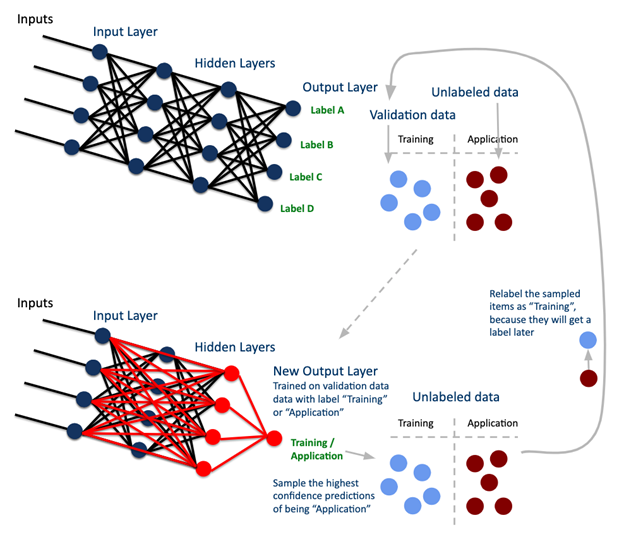
Figure 5.ARATL: Active Transfer Learning for Adaptive Representative Sampling. Because our sampled items will later get a human label, we can assume that they become part of the training data without needing to know what the label is. To begin with, we take validation data from the same distribution as the training data and give it a "Training" label. We then take unlabeled data from our target domain and give it a "Application" label. We train a new output layer to predict the Training/Application labels, giving it access to all layers of the model. We then apply that to the unlabeled data (ignoring the unlabeled items that we just trained on) and sample the items that are most confidently predicted as "Application". Then, we can assume that those items will later get label and become part of the training data. So, we can take those sampled items, change their label from “Application” to “Training”, and then retrain our final layer(s) on the new dataset.