concept AWS in category machine learning

This is an excerpt from Manning's book Machine Learning Bookcamp.
We already tested our application on our laptop, so now let's see how to run it on a public cloud and deploy it to AWS.
Note: Using Ubuntu Linux is recommended for the examples in this book. It's not a strict requirement, however, and you should not have problems running the examples in other operating systems. If you don't have a computer with Ubuntu, it's possible to rent one online in a cloud. Please refer to the “Renting a server on AWS” section for more detailed instructions.
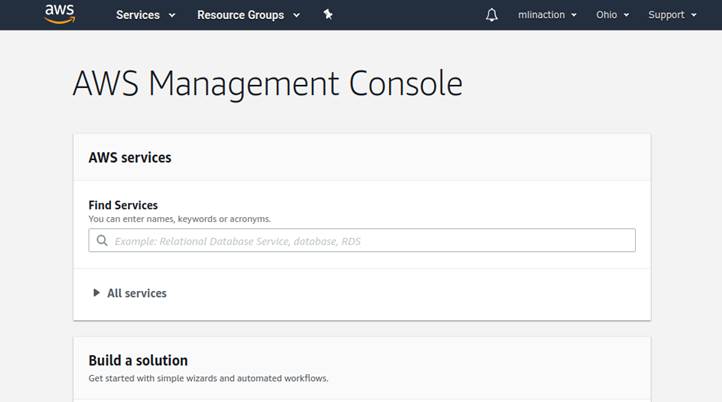
Figure A.13 The AWS Management Console is the starting page for AWS.

This is an excerpt from Manning's book Exploring Machine Learning Basics.
AWS is Amazon’s cloud service. It lets companies of all sizes set up servers and interact with services in the cloud rather than building their own data centers. AWS has dozens of services available to you. These range from compute services such as cloud-based servers (EC2), to messaging and integration services such as SNS (Simple Notification Service) messaging, to domain-specific machine learning services such as Amazon Transcribe (for converting voice to text) and AWS DeepLens (for machine learning from video feeds).

This is an excerpt from Manning's book Machine Learning for Business: Using Amazon SageMaker and Jupyter.
AWS is Amazon’s cloud service. It lets companies of all sizes set up servers and interact with services in the cloud rather than building their own data centers. AWS has dozens of services available to you. These range from compute services such as cloud-based servers (EC2), to messaging and integration services such as SNS (Simple Notification Service) messaging, to domain-specific machine learning services such as Amazon Transcribe (for converting voice to text) and AWS DeepLens (for machine learning from video feeds).
AWS is Amazon’s cloud service. At the time of writing this book, it has a larger share of the cloud service market than either Microsoft or Google, its two biggest competitors.
AWS consists of a large number of services ranging from servers to storage to specialized machine learning applications for text and images. In fact, one of the most difficult aspects of using a cloud service is understanding what each of the components does. While you are encouraged to explore the breadth of AWS services, for this book, we are only going to use two of them: S3 (AWS’s file storage service) and SageMaker (AWS’s machine learning platform).
The next pages’ forms relate to verifying your account. Likely, as a provider of compute services, AWS is subject to attempts by technically savvy users trying to get free services. Accordingly, there are a few steps to the verification process. The first verification step is a security check by typing annoyingly displayed characters (figure A.4).
Clicking Call Me Now kicks off the second verification step, where you’ll receive an automated call from AWS. It will ask you to key in the four-digit code that is displayed on the page (figure A.5).
