concept base estimator in category machine learning
appears as: base estimators, base estimator, base estimators, base estimator

This is an excerpt from Manning's book Ensemble Methods for Machine Learning.
We train a set of diverse base estimators (also known as base learners) using diverse base learning algorithms on the same data set. That is, we count on the significant variations in how each learning algorithm to produce a diverse set of base estimators.
Another reason for their popularity is that they can easily combine existing models, which allows us to use previously trained models as base estimators. For example, say you and a friend were working independently on a data set for a Kaggle competition. You trained an SVM, while your friend trained a logistic regression model. While your individual models are doing ok, you both figure that you may do better if you put your heads (and models) together. You build a heterogeneous ensemble with these existing models without having to train them all over again. All you need to figure out would be a way to combine your two models.
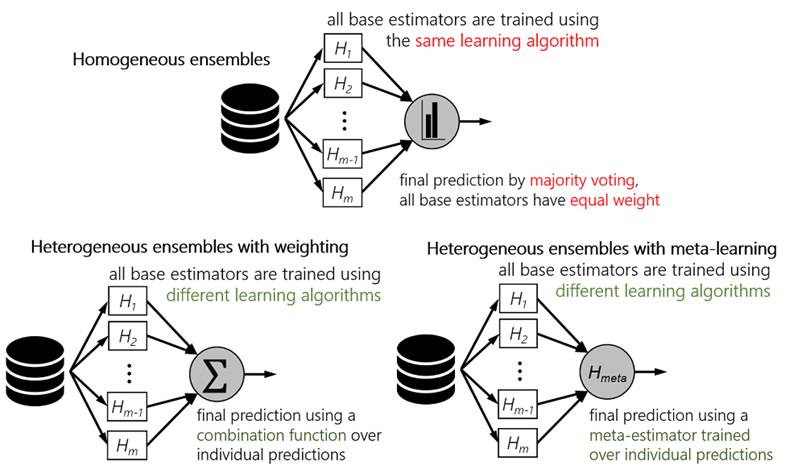
Figure 3.1 Homogeneous ensembles (Chapter 2), such as bagging and random forests, use the same learning algorithm to train base estimators, and achieve ensemble diversity through random sampling. Heterogeneous ensembles (this chapter) use different learning algorithms to achieve ensemble diversity.
Listing 3.2. Individual predictions of base estimators
import numpy as np

def predict_individual(X, estimators, proba=False):     #A
    n_estimators = len(estimators)
    n_samples = X.shape[0]

    y = np.zeros((n_samples, n_estimators))
    for i, (model, estimator) in enumerate(estimators):
        if proba:
            y[:, i] = estimator.predict_proba(X)[:, 1]  #B
        else:
            y[:, i] = estimator.predict(X)              #C
    return y