concept bayesian bandit in category machine learning
appears as: Bayesi bandits, Bayesian bandit, Bayesi bandit

This is an excerpt from Manning's book Algorithms of the Intelligent Web, Second Edition.
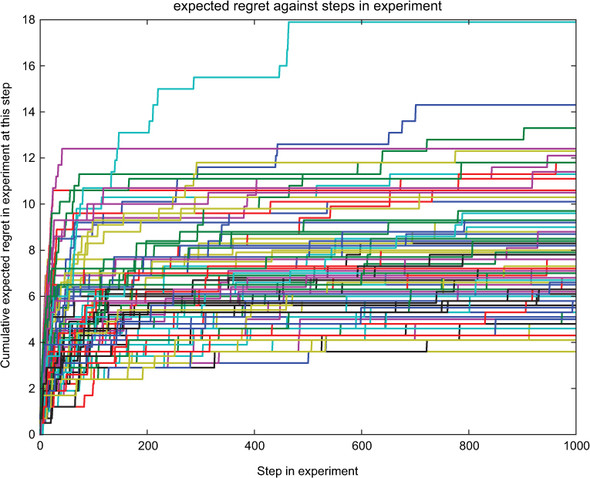
Figure 7.9. Average cumulative expected regret at each step, over 100 iterations. Note that the gradient decreases as the number of steps increases. This is because the Bayesian bandit makes comparative better choices as the experiment continues. Consequently, it’s less likely to incur additional regret.
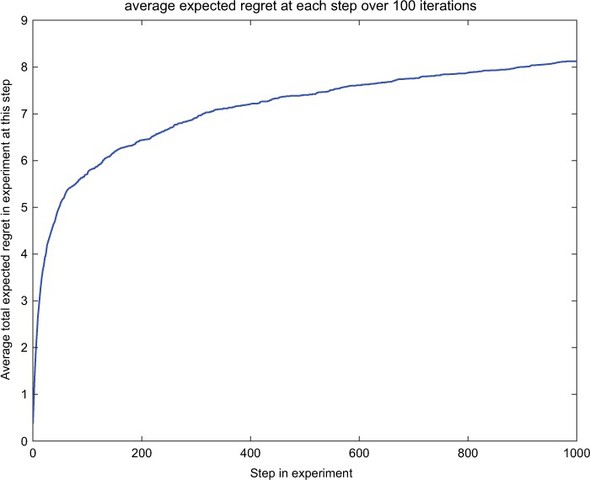
You can see that as the number of steps in the experiment increases, the rate at which regret is accumulated decreases. This is because the Bayesian bandit is, more often, making better decisions on average, at later stages in an individual run. Although the curve in figure 7.9 hasn’t converged within 1,000 steps (that is, the gradient hasn’t dropped to zero), it does look like the Bayesian bandit expects to lose somewhere in the order of 10 payouts when compared to a totally optimal strategy. If we consider that the optimal strategy pays out around 1,000 × 0.8 = 800 times, this isn’t bad at all.