concept category in category machine learning

This is an excerpt from Manning's book Collective Intelligence in Action.
In content-centric applications, users typically navigate content through categories or menus authored by the site editors. Each category can have a number of nested subcategories, allowing the user to drill down the subcategory tree and find content of interest. From a user-experience point of view, such navigation can be tedious. A user might need to navigate across multiple subtopics before finding the right item. This approach of manually categorizing items can be expensive and difficult to maintain over the long run due to the manpower involved, especially as the amount of content increases. As users generate content on your site, it’ll be expensive and sometimes financially infeasible to manually categorize the content being created. Imagine a site like Flickr with millions of photographs and the effort that would be required if you tried to manually categorize each photo.
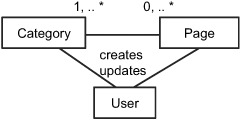
Every wiki consists of a number of categories. Within each category are zero or more pages, as shown in figure 4.4. A page can belong to one or more categories. Users create and edit pages, categories, and the relationship between the pages and the categories.