concept data in category machine learning

This is an excerpt from Manning's book How Machine Learning Works.
The figure above shows how linear model for the diabetes problem we have would look like if it was a good fit to the data; the line separates the diabetics (black dots above the line) from the non-diabetics (below the line). Such line is specified with the following equation:
To start to understand the data and describe it, we first need to understand what the data represents and how it relates to the real-world phenomenon that we're trying to study. That's what we're going to see in the next section.

This is an excerpt from Manning's book Mahout in Action.
How much memory does a GenericDataModel use? The number of preferences stored dominates memory consumption. Some empirical testing reveals that it consumes about 28 bytes of Java heap space per preference. This includes all data and other supporting data structures, like indexes. You can try this if you like: load a GenericDataModel, call System.gc() a few times, and then compare the results of Runtime.totalMemory() and Runtime.freeMemory(). This is crude, but it should give a reasonable estimate of how much memory the data is consuming.
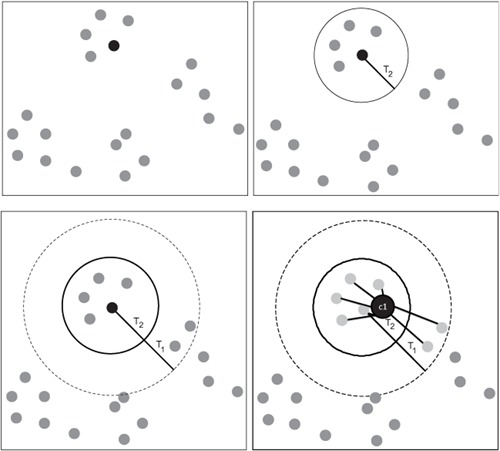
Figure 9.3. Canopy clustering: if you start with a point (top left) and mark it as part of a canopy, all the points within distance T2 (top right) are removed from the data set and prevented from becoming new canopies. The points within the outer circle (bottom-right) are also put in the same canopy, but they’re allowed to be part of other canopies. This assignment process is done in a single pass on a mapper. The reducer computes the average of the centroid (bottom right) and merges close canopies.
First, we attempt to use the public tweets from Twitter (http://twitter.com) to find people who tweet alike using clustering. Second, we examine a data set from Last.fm (http://last.fm), a popular Internet radio website, and try to generate related tags from the data. Finally, we take the full data dump of a popular technology discussion website, Stack Overflow (http://stackoverflow.com), which has around 500,000 questions and 200,000 users. We use this data set to implement related-features functionality for the website.