concept decision in category machine learning
This is an excerpt from Manning's book Machine Learning with TensorFlow, Second Edition.
Social media companies, phone providers, and app makers are all trying to use the messages you send to make decisions and classify you. Have you ever sent your significant other an SMS text message about the Thai food you ate for lunch and then later saw ads on your social media pop up recommending new Thai restaurants to visit? Scary as it seems that big brother is trying to identify and understand your food habits, there are also very practical applications used by online streaming service companies trying to determine if you enjoyed their films or not.
HMMs are explainable models that accumulate probabilistic evidence and help guide decisions based on possible states that that evidence represents.
Listing 13.7 Using a given policy to make decisions, and returning the performance
def run_simulation(policy, initial_budget, initial_num_stocks, prices, hist):
    budget = initial_budget                  #A
    num_stocks = initial_num_stocks          #A
    share_value = 0                          #A
    transitions = list()
    for i in range(len(prices) - hist - 1):
        if i % 1000 == 0:
            print('progress {:.2f}%'.format(float(100*i) / (len(prices) - hist - 1)))
        current_state = np.asmatrix(np.hstack((prices[i:i+hist], budget, num_stocks)))                                                  #B
        current_portfolio = budget + num_stocks * share_value           #C
        action = policy.select_action(current_state, i)                 #D
        share_value = float(prices[i + hist])
        if action == 'Buy' and budget >= share_value:        #E
            budget -= share_value
            num_stocks += 1
        elif action == 'Sell' and num_stocks > 0:            #E
            budget += share_value
            num_stocks -= 1
        else:                                                #E
            action = 'Hold'
        new_portfolio = budget + num_stocks * share_value    #F
        reward = new_portfolio - current_portfolio                #G
        next_state = np.asmatrix(np.hstack((prices[i+1:i+hist+1], budget, num_stocks)))
        transitions.append((current_state, action, reward, next_state))
        policy.update_q(current_state, action, reward, next_state)    #H

    portfolio = budget + num_stocks * share_value                   #I
    return portfolio

This is an excerpt from Manning's book Grokking Machine Learning.
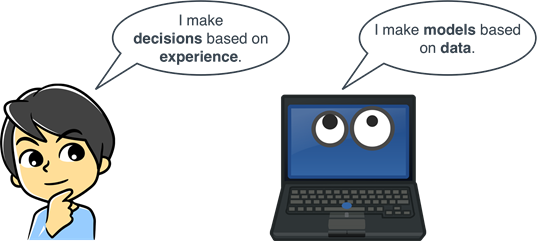
Welcome to this book! I’m super happy to be joining you in this journey through understanding machine learning. At a high level, machine learning is a process in which the computer solves problems and makes decisions in a similar way that humans do.
In the same way that humans make decisions based on previous experiences, computers can make decisions based on previous data. The rules computers use to make decisions are called models.
Figure 1.2. Machine learning is about computers making decisions based on experience.

This is an excerpt from Manning's book Exploring Machine Learning Basics.
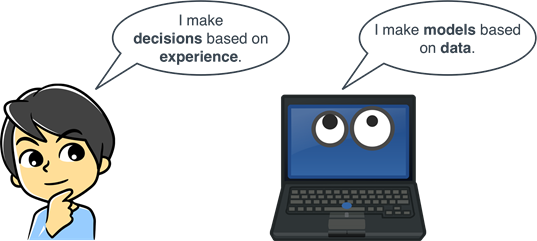
Welcome to this book! I’m super happy to be joining you in this journey through understanding machine learning. At a high level, machine learning is a process in which the computer solves problems and makes decisions in a similar way that humans do.
In the same way that humans make decisions based on previous experiences, computers can make decisions based on previous data. The rules computers use to make decisions are called models.
Figure 1.2. Machine learning is about computers making decisions based on experience.
Now imagine that, instead of being the driver, your job is to support the drivers by providing them with tires during the race. You’re the Chief Tire Officer (CTO). And imagine that instead of three different types of terrain, you have hundreds, and instead of a few drivers in the race, you have thousands. As CTO, the decision is easy: you’ll choose the all-terrain tires for all but the most specialized terrains, where you’ll reluctantly concede that you need to provide specialty tires. As a driver, the CTO’s decision sometimes leaves you dissatisfied because you end up with a system that is clunkier than the systems you use in your personal life.
As you read through other resources on machine learning, you will see that machine learning can cover many other things. But most of these things can be broken down into a series of decisions. Take machine learning systems for autonomous cars, for example. On the face of it, this sounds very different from the machine learning we are looking at. But it is really just a series of decisions. One machine learning algorithm looks at a scene and decides how to draw boxes around each of the objects in the scene. Another machine learning algorithm decides whether these boxes are things that need to be driven around. And, if so, a third algorithm decides the best way to drive around them.
To determine whether you can use machine learning to help out Karen, let’s look at the decisions made in Karen’s process. When an order comes in, Karen needs to decide whether to send it straight to the requester’s financial approver or whether she should send it to a technical approver first. She needs to send an order to a technical approver if the order is for a technical product like a computer or a laptop. She does not need to send it to a technical approver if it is not a technical product. And she does not need to send the order for technical approval if the requester is from the IT department. Let’s assess whether Karen’s example is suitable for machine learning.

This is an excerpt from Manning's book Machine Learning for Business: Using Amazon SageMaker and Jupyter.
Now imagine that, instead of being the driver, your job is to support the drivers by providing them with tires during the race. You’re the Chief Tire Officer (CTO). And imagine that instead of three different types of terrain, you have hundreds, and instead of a few drivers in the race, you have thousands. As CTO, the decision is easy: you’ll choose the all-terrain tires for all but the most specialized terrains, where you’ll reluctantly concede that you need to provide specialty tires. As a driver, the CTO’s decision sometimes leaves you dissatisfied because you end up with a system that is clunkier than the systems you use in your personal life.
As you read through other resources on machine learning, you will see that machine learning can cover many other things. But most of these things can be broken down into a series of decisions. Take machine learning systems for autonomous cars, for example. On the face of it, this sounds very different from the machine learning we are looking at. But it is really just a series of decisions. One machine learning algorithm looks at a scene and decides how to draw boxes around each of the objects in the scene. Another machine learning algorithm decides whether these boxes are things that need to be driven around. And, if so, a third algorithm decides the best way to drive around them.
To determine whether you can use machine learning to help out Karen, let’s look at the decisions made in Karen’s process. When an order comes in, Karen needs to decide whether to send it straight to the requester’s financial approver or whether she should send it to a technical approver first. She needs to send an order to a technical approver if the order is for a technical product like a computer or a laptop. She does not need to send it to a technical approver if it is not a technical product. And she does not need to send the order for technical approval if the requester is from the IT department. Let’s assess whether Karen’s example is suitable for machine learning.