concept deep learning in category machine learning

This is an excerpt from Manning's book Grokking Machine Learning.
Deep learning is arguably the most commonly used type of machine learning. The reason is simply that it works really well. If you are looking at any of the cutting edge applications, such as image recognition, language generation, playing Go, or self driving cars, very likely you are looking at deep learning in some way or another. But what exactly is deep learning? This term applies to every type of machine learning that uses Neural Networks. Neural networks are one type of algorithm, which we learn in Chapter 5.
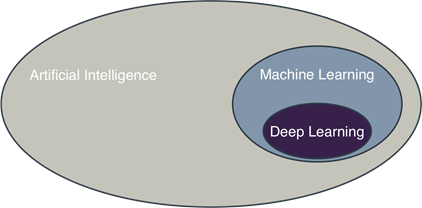
So in other words, deep learning is simply a part of machine learning, which in turn is a part of artificial intelligence. If this book was about vehicles, then AI would be motion, ML would be cars, and deep learning (DL) would be Ferraris.
Figure 1.4. Deep learning is a part of machine learning.

This is an excerpt from Manning's book Exploring Machine Learning Basics.
Deep learning is arguably the most commonly used type of machine learning. The reason is simply that it works really well. If you are looking at any of the cutting edge applications, such as image recognition, language generation, playing Go, or self driving cars, very likely you are looking at deep learning in some way or another. But what exactly is deep learning? This term applies to every type of machine learning that uses Neural Networks. Neural networks are one type of algorithm, which we learn in Chapter 5.
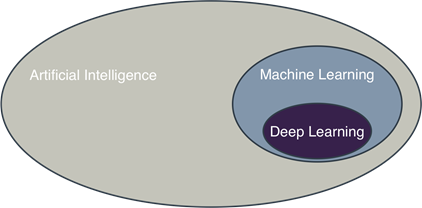
So in other words, deep learning is simply a part of machine learning, which in turn is a part of artificial intelligence. If this book was about vehicles, then AI would be motion, ML would be cars, and deep learning (DL) would be Ferraris.
Figure 1.4. Deep learning is a part of machine learning.

This is an excerpt from Manning's book Machine Learning with R, the tidyverse, and mlr.
Deep learning is a subfield of machine learning, which is, itself, a subfield of AI.
If you’ve done more than a little reading about machine learning, you have probably come across the term deep learning, and you may have even heard the term in the media. Deep learning is a subfield of machine learning (all deep learning is machine learning, but not all machine learning is deep learning) that has become extremely popular in the last 5 to 10 years for two main reasons:
Deep learning uses neural networks to learn patterns in data, a term referring to the way in which the structure of these models superficially resembles neurons in the brain, with connections to pass information between them. The relationship between AI, machine learning, and deep learning is summarized in figure 1.7.
Figure 1.6. Classification, regression, dimension reduction, and clustering. Classification and regression algorithms build models that predict categorical and continuous variables of unlabeled, new data, respectively. Dimension-reduction algorithms create a new representation of the original data in fewer dimensions and map new data onto this representation. Clustering algorithms identify clusters within the data and map new data onto these clusters.


This is an excerpt from Manning's book Algorithms of the Intelligent Web, Second Edition.
There is much discussion about deep learning at the moment, and it’s widely seen to be the next big advance in machine learning and artificial intelligence. In this chapter, we’d like to cut through the rhetoric to provide you with the facts. At the end of this chapter, you should understand the basic building block of any deep learning network, the perceptron, and understand how these fit together in a deep network. Neural networks heralded the introduction of the perceptron, so we’ll discuss these before exploring deeper, more expressive networks. These deeper networks come with significant challenges in representation and training, so we need to ensure a good foundational knowledge before leaping in.
Before we do all of this, we’ll discuss the nature of deep learning and the kinds of problems deep learning has been applied to and what makes these successful. This should give you a foundational motivation for deep learning and a frame on which to hang some of the more complicated theoretical concepts later in the chapter. Remember that this is a still a vibrant and active area of research in the community, so I recommend that you keep abreast of the latest advances by following the literature. Startup.ML[1] and KDNuggets[2] are just a couple of the resources that can provide you with an up-to-date summary of what’s happening in the community. But I urge you to do your own research and come up with your own conclusions!
In order to understand deep learning, let’s choose the application of image recognition; namely, given a picture or a video, how do we build classifiers that will recognize objects? Such an application has potentially wide-reaching applications. With the advent of the quantified self[3], [4] and Google Glass, we could imagine applications that recognize objects visible to the user and provide augmented visuals through their glasses.