concept group in category machine learning

This is an excerpt from Manning's book Machine Learning Bookcamp.
Ranking — The target variable y is an ordering of elements within a group, such as the order of pages in a search-result page. The problem of ranking often happens in areas like search and recommendations, but it's out of the scope of this book and we won't cover it in detail.
Risk is a number between 0 and infinity. It has a nice interpretation that tells u, how likely the elements of the group are to have the effect (churn) compared with the entire population.
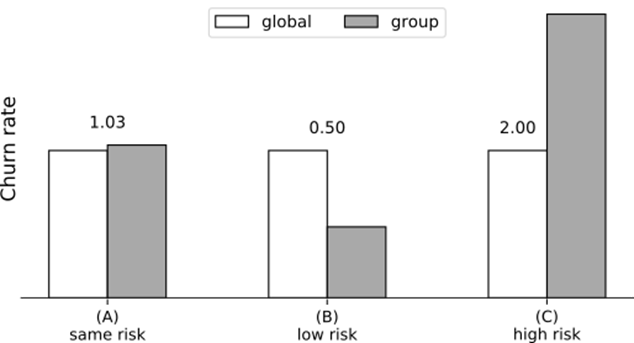
If the difference between the group rate and the global rate is small, the risk will be close to 1. This group has the same level of risk as the rest of the population. So customers in the group are as likely to churn as anyone else. In other words, a group with risk close to 1 is not risky at all (figure 3.15, group A).
If the risk is lower than 1, the group has lower risks: the churn rate in this group is smaller than the global churn. For example, the value 0.5, for example, means that the clients in this group are two times less likely to churn than clients in general (figure 3.15, group B).
On the other hand, if the value is higher than 1, the group is risky: there's more churn in the group than in the population. So a risk of 2 means that customers from the group are two times more likely to churn (figure 3.15, group C).
Figure 3.15 Churn rate of different groups compared with the global churn rate. In group (A) the rates are approximately the same, so the risk of churn is around 1. In group (B) the group churn rate is smaller than the global rate, so the risk is around 0.5. Finally, in group (C) the group churn rate is higher than the global rate, so the risk is close to 2.
risk = negative outcome rate in group 1 / negative outcome rate in group 2

This is an excerpt from Manning's book Collective Intelligence in Action.
Collective intelligence is an active field of research that predates the web. Scientists from the fields of sociology, mass behavior, and computer science have made important contributions to this field. When a group of individuals collaborate or compete with each other, intelligence or behavior that otherwise didn’t exist suddenly emerges; this is commonly known as collective intelligence. The actions or influence of a few individuals slowly spread across the community until the actions become the norm for the community. To better understand how this circle of influence spreads, let’s look at a couple of examples.
In his book The Hundredth Monkey,[1] Ken Keyes recounts an interesting story about how change is propagated in groups. In 1952, on the isolated Japanese island of Koshima, scientists observed a group of monkeys. They offered them sweet potatoes; the monkeys liked the sweet potatoes but found the taste of dirt and sand on the potatoes unpleasant. One day, an 18-month-old monkey named Imo found a solution to the problem by washing the potato in a nearby stream of water. She taught this trick to her mother. Her playmates also learned the trick and taught it to their mothers. Initially, only adults who imitated their children learned the new trick, while the others continued eating the old way. In the autumn of 1958, a number of monkeys were washing their potatoes before eating. The exact number is unknown, but let’s say that out of 1,000, there were 99 monkeys who washed their potatoes before eating. Early one sunny morning, a 100th monkey decided to wash his potato. Then, incredibly, by evening all monkeys were washing their potatoes. The 100th monkey was that tipping point that caused others to change their habits for the better. Soon it was observed that monkeys on other islands were also washing their potatoes before eating them.
Message boards are places where you can ask questions and others can respond to them, as well as rate them for usefulness. Message boards are usually associated with groups. A group is a collection of users that share a common interest, where users can participate in threaded conversations. Groups usually have a mailing list associated with them where members can get updates over email. Yahoo! has more than a million groups on virtually every subject, from data mining, to groups on companies, dogs, and marathons. There are hundreds of message boards, and you can find a list of them at http://www.topology.org/net/mb.html and http://dmoz.org/Computers/Internet/On_the_Web/Message_Boards/.
As shown in table 4.4, groups, topics, questions, messages, and users are the main entities for groups and message boards.
Table 4.4. Entities for message boards and groups
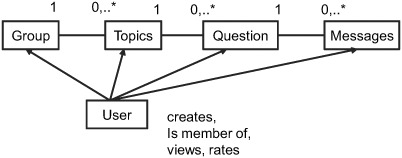
Entity
Description
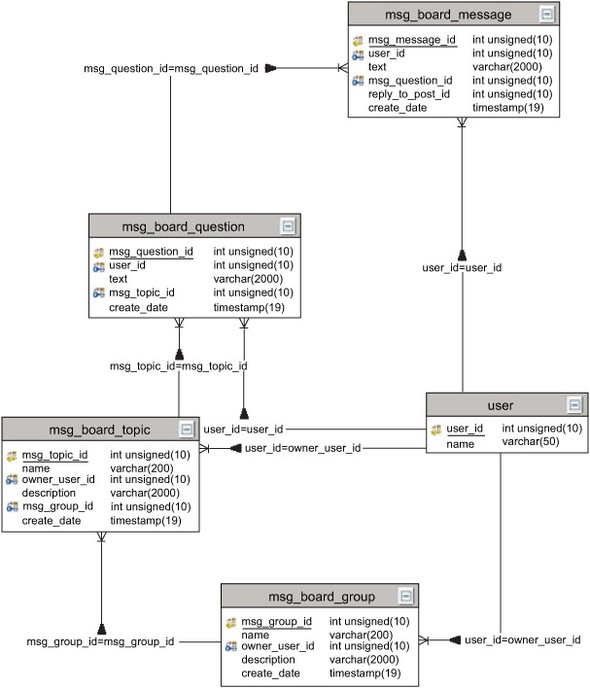
Groups Collections of users that have a common cause or interest Topics Groups consist of a number of topics or categories Questions Users pose questions within a topic Messages Posted in response to a question or an answer provided User Can create, become a member of, view, or rate any of the above entities As shown in figure 4.6, each group consists of a number of topics; each topic has a number of questions; each question has a number of messages or answers. A user can belong to multiple groups; can create a group, topic, question, or answer; and can rate any of these entities. Again, groups, topics, and question are all examples of CompositeContentTypes, which we discuss in section 4.3. Figure 4.7 shows the schema for the elements of a message board.
In this section, we’ve looked at three content types that are typically associated with collective intelligence: blogs, wikis, and groups and message boards. We’ve looked at the elements of these content types, how they’re used, and the relationship between their various elements. Now we’re ready to take a more detailed look at how intelligence is extracted from analyzing content.