concept human in category machine learning

This is an excerpt from Manning's book Grokking Machine Learning.
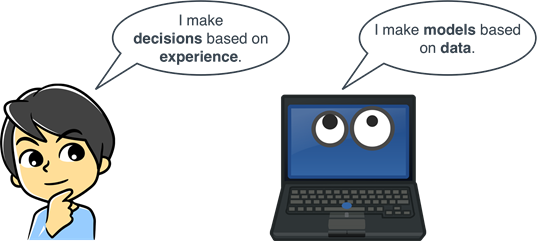
Welcome to this book! I’m super happy to be joining you in this journey through understanding machine learning. At a high level, machine learning is a process in which the computer solves problems and makes decisions in a similar way that humans do.
In the same way that humans make decisions based on previous experiences, computers can make decisions based on previous data. The rules computers use to make decisions are called models.
Figure 1.2. Machine learning is about computers making decisions based on experience.

This is an excerpt from Manning's book Human-in-the-Loop Machine Learning.
Unlike robots in the movies, most of today’s Artificial Intelligence (AI) cannot learn by itself: it relies on intensive human feedback. Probably 90% of Machine Learning applications today are powered by Supervised Machine Learning. This covers a wide range of use cases: an autonomous vehicle can drive you safely down the street because humans have spent thousands of hours telling it when its sensors are seeing a ‘pedestrian’, ‘moving vehicle’, ‘lane marking’, and every other relevant object; your in-home device knows what to do when you say ‘turn up the volume’, because humans have spent thousands of hours telling it how to interpret different commands; and your Machine Translation service can translate between languages because it has been trained on thousands (or maybe millions) of human-translated texts.
Figure 6.8: An example of stratified sampling by label applied to segmentation. For this example task, let’s we assume that we care about errors related to human and bicycle pixels more than we care about errors related to tree and sky pixels. So, our Active Learning sample will consist of a 90:10 split: 90% will be the most confusing samples for the labels that we are about the most and 10% will be about the labels that we don’t care about. Note that the pixels bordering the sky and trees vastly outnumber the pixels bordering humans and bicycles, so stratified sampling helps us focus on the errors that care most about. This might diverge from your accuracy evaluation strategy, where you can simply apply relative weights of 90% and 10% to high/low value errors. The Uncertainty Sampling metrics don’t lend themselves as easily to this kind of weighting, so unless you are confident enough in your statistics skills to tune your weighting strategy, it is recommended that you use this stratification method.

For many tasks, the goal is to assist human processes. In fact, many models could be used either for automation or to assist humans, depending on the application. For example, you could train a collision detection algorithm to either power a fully autonomous vehicle or to alert the driver. Similarly, you could train a medical imaging algorithm to make diagnoses or to inform a medical practitioner’s decision making.

This is an excerpt from Manning's book Exploring Machine Learning Basics.
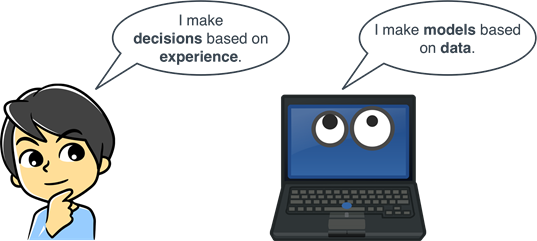
Welcome to this book! I’m super happy to be joining you in this journey through understanding machine learning. At a high level, machine learning is a process in which the computer solves problems and makes decisions in a similar way that humans do.
In the same way that humans make decisions based on previous experiences, computers can make decisions based on previous data. The rules computers use to make decisions are called models.
Figure 1.2. Machine learning is about computers making decisions based on experience.

This is an excerpt from Manning's book Algorithms of the Intelligent Web, Second Edition.
Conversely, humans are excellent all-purpose computation machines! They can easily understand new concepts and apply knowledge learned in one domain to another. They come with a variety of actuators (!) and are programmable in many different languages (!!). It’s a mistake to think that we can easily write code-driven solutions to replace seemingly simple human processes.