concept human annotation in category machine learning

This is an excerpt from Manning's book Human-in-the-Loop Machine Learning.
Diversity Sampling can mean using intrinsic properties of the dataset, like the distribution of labels. For example, you might want to deliberately try to get an equal number of human annotations for each label, even though some labels are much rarer than others. Diversity Sampling can also mean ensuring that the data is representative of important external properties of the data, like ensuring that data comes from a wide variety of demographics of the people represented in the data, in order to overcome real-world bias in the data. We will cover all these variations in depth in the chapter on Diversity Sampling.
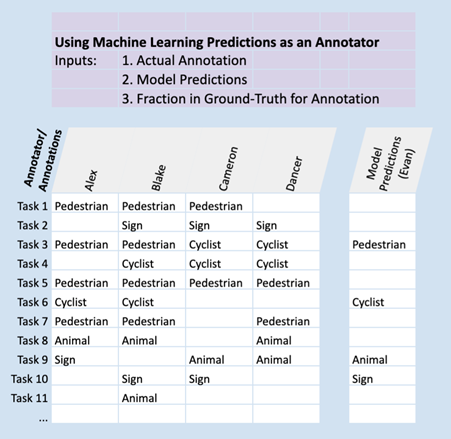
To evaluate how accurate this model is, you will need to split your ground-truth data into training and evaluation data, so that you can evaluate the confidence on held out data. If you are using anything more complicated than a linear model or single neuron, such that you are doing hyperparameter tuning, then you will also need a further split to create a validation set that you can use for tuning. Both the sparse and aggregate representations are also compatible with using a model’s predictions as if it was an annotator. For the aggregate representation, you might think about whether you want to separately aggregate model predictions from human annotations.
Figure 9.13 Incorporating predictions from a model as if they were annotations. From our example data, we can assume that “Evan” was, in fact, a predictive model and not a human annotator. For any of our methods that take into account the accuracy of each annotator, it is generally fine to incorporate model predictions as human annotations in this part of the workflow.