concept neural model in category machine learning

This is an excerpt from Manning's book Human-in-the-Loop Machine Learning.
Retraining part of a neural model to adapt to a new task (pre-trained models), OR
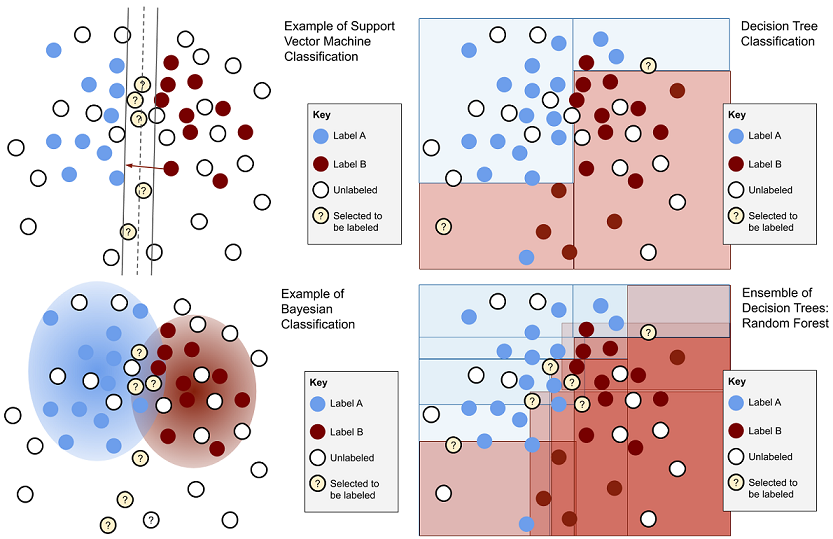
Bottom Right shows an ensemble of Decision Trees, of which the most well-known variant is a “Random Forest”. Multiple decision trees are trained. The different trees are usually achieved by training on different subsets of the data and/or features. The confidence in a label can simply be the percent of times an item was predicted across all models, or the average confidence across all predictions.
Bottom Left shows the division that a Decision Tree might give, dividing and recursively subdividing the data one feature at time. The confidence is defined by the percent of a label in the final bucket (leaf). For example, in the bottom left bucket (leaf) there is 1 Label A and 3 Label B, so a prediction in that bucket (leaf) would be 25% confidence in Label A and 75% confidence in Label B. Decision Trees are very sensitive to how far you let them divide - they could keep dividing to leaves of just one items - and so probabilities tend not to be reliable.
Top Right shows a potential Bayesian Model. It is a Generative Supervised Learning model which means that is trying to model the distribution of each label, rather than model the boundary between them. The confidence on a per-label basis can be read directly as a probability of being that label.
Top Left shows the decision boundary from a Support Vector Machine. It is a discriminative learner, like a neural model, attempting to find a way to optimally divide the data. Unlike neural classifiers, SVMs are also trying to maximize the width of the boundary. This is how an SVM decides which of multiple possible “central” lines is the best division: it has the widest boundary. Note that the distance from the divider (the “hyperplane” for SVMs) is from the far side of the divider, not the middle line.
Figure 3.8: Uncertainty Sampling from different Supervised Machine Learning algorithms
If you are using a neural model, then you might be ok if you have well-represented data that is not representative. Provided there is enough data, a neural model can be accurate for all items in a given demographic even if trained on data that was imbalanced within that demographic. For example, the Uganda news articles might be balanced too much towards sports-related articles. Provided there are sufficient examples of the other types of news from Uganda for your model to be accurate on those topics, then it won’t matter that sports-related news is over-represented: your model will be accurate on all types of news from Uganda.