concept other annotator in category machine learning

This is an excerpt from Manning's book Human-in-the-Loop Machine Learning.
If you are already familiar with the literature on quality control for annotation, then you know that a metric that is normalized according to the expected behavior is often called “chance-corrected” or “chance-adjusted”. There are many cases that you will learn about in this chapter where the expected behavior is not random chance, like when we ask annotators what they expect other annotators to choose, which is one of the advanced methods in the next chapter. So, the more general term “expected” is used here, but for objective labeling tasks they all essentially mean the same thing.
The easiest way to understand the possible answers is to ask the annotators directly. That is, for each question, ask the annotators what they think that other annotators might respond. An example is in Figure 9.2.
Figure 9.2: Asking people what they expect other annotators to choose for answers. Here, the annotator has indicated that they think that the image is a “Pedestrian” and that 90% of annotators will agree with them, but 10% will think that it is a sign. This motivates people to give honest responses, gives the data to decide whether multiple responses really are valid, and allows us to capture more diversity in correct answers than the ones offered by any one annotator.
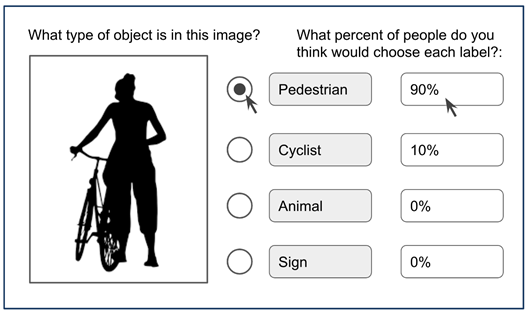
The interface is very similar to the example in the last chapter where we asked annotators to give their own confidence for each label, but here instead we are asking them about other annotators. This relatively simple change has a number of desirable properties: