concept overfitting in category machine learning

This is an excerpt from Manning's book Grokking Machine Learning.
As I mentioned before, neural networks are very prone to overfitting. In this section I’ll teach you some techniques to decrease the amount of overfitting during the training of neural networks.
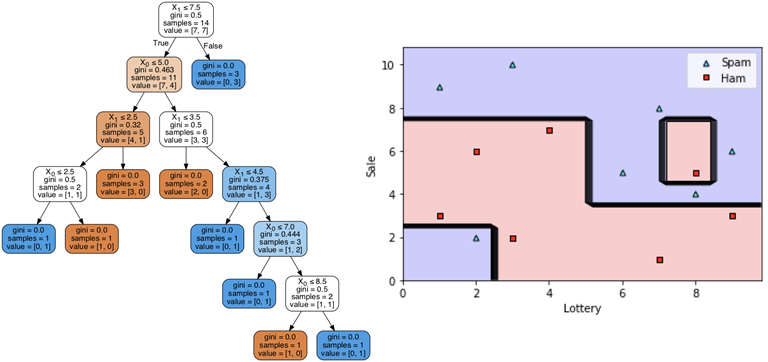
Figure 10.5. Left: A decision tree that classifies our dataset. Right: The boundary defined by this decision tree. Notice that it splits the data very well, although it hints at overfitting, since the two isolated points would rather be treated as errors.

This is an excerpt from Manning's book Ensemble Methods for Machine Learning.
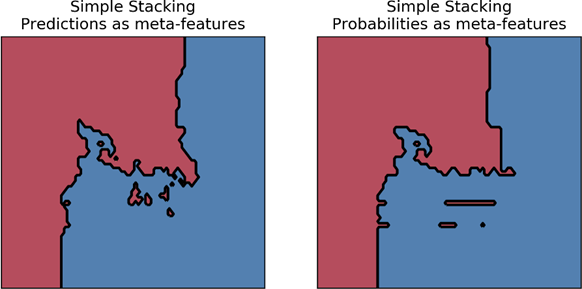
This simple stacking procedure is often effective. However, it does suffer from one significant drawback: overfitting, especially in the presence of noisy data. The effects of overfitting can be observed in the figure below. In the case of stacking, the overfitting is because we used the same data set to train all the base estimators.
Figure 3.14 Stacking can overfit the data. There is clear evidence of overfitting here: the decision boundaries are highly jagged and have small islands, where the classifiers have attempted to fit individual, noisy examples.
To guard against overfitting, we can incorporate k-fold cross validation such that each base estimator is not trained on the exact same data set. You may have previously encountered and used cross validation for parameter selection and model evaluation.
Here, we use cross validation to partition the data set into subsets so that different base estimators are trained on different subsets. This often leads to more diversity and robustness, while decreasing the chances of overfitting.

This is an excerpt from Manning's book Machine Learning for Business: Using Amazon SageMaker and Jupyter.
Richie’s explanation of overfitting
We touched on overfitting earlier in the XGBoost explanation. Overfitting is the process of building a model that maps too closely or exactly to the provided training data and fails to predict unseen data as accurately or reliably. This is also sometimes known as a model that does not generalize well. Unseen data includes test data, validation data, and data that can be provided to our endpoint in production.