concept polygon in category machine learning

This is an excerpt from Manning's book Human-in-the-Loop Machine Learning.
However, when you are dealing with more complicated interfaces, the conventions become more complicated. Imagine you are asking people to put polygons around certain objects in an image, which is a common use case for autonomous vehicle companies. What modalities would an annotator expect? Would they expect free-hand, lines, paint-brushes, smart selection by color/region, and other selection tools? If people are accustomed to working on images in programs like Adobe PhotoShop, then they might be expecting the same functionality for annotating images for Machine Learning. Just as you are building on and constrained by people’s expectations for web forms, you are constrained by their expectations for selecting and editing images. Unfortunately, those expectations might require 100s of hours of coding to build if you are offering fully-featured interfaces.
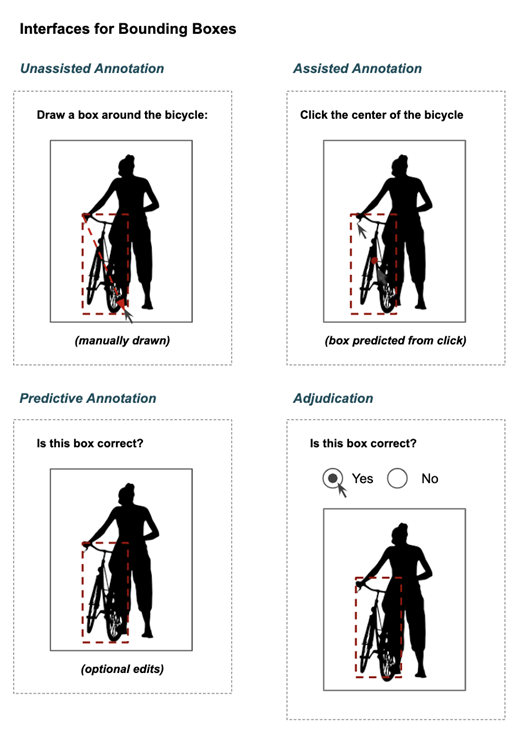
If you are using polygons, rather than bounding boxes, as in Figure 6.6, all the methods here still apply.
Figure 11.7: Different types of Bounding Box annotation interfaces. An unassisted annotation interface has the annotator manually drawing the box (or polygon). In many cases the box can be guessed for predictive annotation interfaces that a person can edit or adjudicate (bottom row). For assisted interfaces, the annotator can click the middle of the object and the interface then predicts the most likely bounding box for that click.