concept preference in category machine learning

This is an excerpt from Manning's book Mahout in Action.
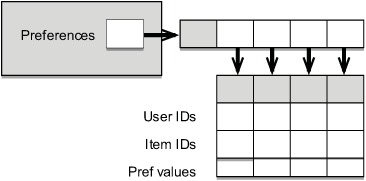
The recommender requires input—data on which it will base its recommendations. This data takes the form of preferences in Mahout-speak. Because the recommender engines that are most familiar involve recommending items to users, it’ll be most convenient to talk about preferences as associations from users to items—though, as noted previously, these users and items could be anything. A preference consists of a user ID and an item ID, and usually a number expressing the strength of the user’s preference for the item. IDs in Mahout are always numbers—integers, in fact. The preference value could be anything, as long as larger values mean stronger positive preferences. For instance, these values might be ratings on a scale of 1 to 5, where 1 indicates items the user can’t stand, and 5 indicates favorites.
for every item i that u has no preference for yet
  for every other user v that has a preference for i
    compute a similarity s between u and v
    incorporate v's preference for i, weighted by s, into a running average
return the top items, ranked by weighted average
The outer loop simply considers every known item (that the user hasn’t already expressed a preference for) as a candidate for recommendation. The inner loop looks to any other user who has expressed a preference for this candidate item, and sees what their preference value for it was. In the end, the values are averaged to come up with an estimate—a weighted average, that is. Each preference value is weighted in the average by how similar that user is to the target user. The more similar a user, the more heavily their preference value is weighted.
The slope-one name comes from the fact that the recommender algorithm starts with the assumption that there’s some linear relationship between the preference values for one item and another, that it’s valid to estimate the preferences for some item Y based on the preferences for item X, via some linear function like Y = mX + b. Then the slope-one recommender makes the additional simplifying assumption that m = 1: slope one. It just remains to find b = Y - X, the (average) difference in preference value, for every pair of items.
for every item i the user u expresses no preference for
  for every item j that user u expresses a preference for
    find the average preference difference between j and i
    add this diff to u's preference value for j
    add this to a running average
return the top items, ranked by these averages