concept production in category machine learning

This is an excerpt from Manning's book Machine Learning for Business: Using Amazon SageMaker and Jupyter.
We touched on overfitting earlier in the XGBoost explanation. Overfitting is the process of building a model that maps too closely or exactly to the provided training data and fails to predict unseen data as accurately or reliably. This is also sometimes known as a model that does not generalize well. Unseen data includes test data, validation data, and data that can be provided to our endpoint in production.
The final stage of the project was to roll out the process across all of WorkPac. This is typically time consuming as it involves building error-catching routines that allow the process to function in production, and training staff in the new process. Although time consuming, this stage can be low risk, providing the feedback from the stage 2 users is positive.
Implementing the algorithm in production was simply a matter of replacing the human decision point with the machine learning algorithm. Instead of making the decision, Faethm’s expert staff spend their time validating the results. As it takes less time to validate than it does to classify, their throughput is greatly improved.

This is an excerpt from Manning's book Mahout in Action.
This chapter identifies those cases where Mahout is a good approach for classification and explains why it offers an advantage over other approaches. As an introduction to classification, this chapter also explains what classification is, and provides a foundation to understanding the basic terminology and concepts. In addition, we present a practical overview of how classification works, covering three stages in the workflow for typical classification projects: training the model, evaluating and tuning the model, and using the model in production. Following this introduction, we look at a simple classification project and show you, in a simple step-by-step way, how to put these basic ideas into practice.
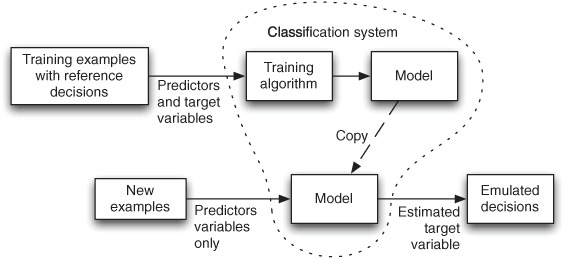
The basic steps in building a classification system are illustrated in figure 13.2. The figure shows two phases of the classification process: the upper path represents the training of the classification model; the lower path provides new examples to the model, which will assign categories (the target variables) as a way to emulate decisions. Input for the training algorithm consists of example data labeled with known target variables. The target variables are, of course, unknown to the model when using new examples during production. In evaluation, the value of the target variable is known, but it won’t be given to the model.
Figure 13.2. How a classification system works. Inside the dotted lasso is the heart of the classification system—a training algorithm that trains a model to emulate human decisions. A copy of the model is then used in evaluation or in production with new input examples to estimate the target variable.
Once the model performs as desired, it’s typically put into production and given additional examples to classify, for which the correct decision is unknown. Production results are usually not 100 percent accurate, but the quality of the output should stay consistent with what was achieved during the test runs unless the quality of the input data or external conditions changes.