concept recommendation engine in category machine learning

This is an excerpt from Manning's book Algorithms of the Intelligent Web, Second Edition.
Let’s say that you have an online movie service that sells or makes money from movie downloads and streaming. Registered users log in to your application and can watch trailers of available movies. If a user likes a particular movie, she can add it to her shopping cart and purchase it later when she’s ready to check out from your store. Naturally, when users complete their purchase, or when they land on the pages of your hypothetical application, you want to suggest more movies to them. There are millions of movies and TV shows available, drawn from many different genres. In addition, many people are sensitive to the kind of shows and movies that they don’t like, so when you display content for a user, you want to target the genre the user likes and avoid those they don’t. If that sounds difficult, fear not. Recommendation engines are here to help you deliver the right content to your users.
A recommendation engine examines the selections that a user has made in the past and identifies the degree to which he would like a certain item that he hasn’t seen yet. It can be used to determine what types of shows your user prefers and the extent to which he does so, by comparing the similarity of his preferences with the characteristics of genres. For a more creative twist, you could help people establish a social network on that site based on the similarity of their movie and TV show tastes. It quickly becomes apparent that the crucial functional element of recommendation engines is the ability to define how similar to each other two (or more) users or two (or more) items are. That similarity can later be used to provide recommendations.
Now that you’re armed with a good understanding of what similarity between two users or two items means, we can proceed with our description of recommendation engines. Generally speaking, there are two categories of recommendation engines. The first broad category is based on the analysis of the content—associated with the items or the users or both. The main characteristic of this content-based approach is the accumulation and analysis of information related to both users and items. That information may be provided either by the software system or through external sources. The system can collect information about the users explicitly through their response to solicited questionnaires or implicitly through the mining of each user’s profile or news-reading habits, emails, blogs, and so on. We won’t cover this category of recommendation engines in detail because it requires a large degree of manual design, and intervention is rather application specific.

This is an excerpt from Manning's book Collective Intelligence in Action.
The process of finding patterns and trends that would otherwise go undetected in large datasets using automated algorithms is known as data mining. When the data is in the form of text, the mining process is commonly known as text data mining. Another related field is information retrieval, which deals with finding relevant information by analyzing the content of the documents. Web and text mining deal with analyzing unstructured content to find patterns in them. Most applications are content-rich. This content is indexed by search engines and can be used by the recommendation engine to recommend relevant content to a user.
Recommendation engines aim to show items of interest to a user. Recommendation engines in essence are matching engines that take into account the context of where the items are being shown and to whom they’re being shown.
Recommendation engines are one of the best ways of utilizing collective intelligence in your application.
Netflix, the world’s largest online movie rental service, provides a good proofpoint of how important recommendation engines are to commerce. Netflix offers personalized recommendations to over 8.4 million subscribers with a catalog of more than 100,000 movie titles.[1] Netflix’s recommendation engine is very effective, with about 60 percent of Netflix members selecting their movies based on movie recommendations that have been tailored to their individual tastes. Later in this chapter (see section 12.4.3), we briefly review the approach Netflix took to build their recommendation system.
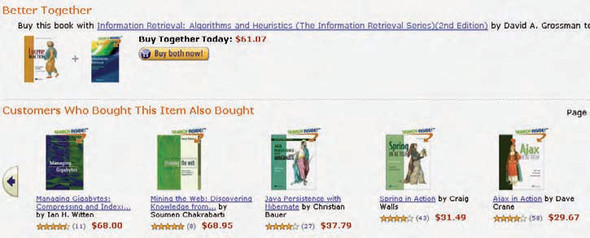
Figure 12.1. An example of the output of a recommendation engine at Amazon.com