concept search in category machine learning

This is an excerpt from Manning's book Collective Intelligence in Action.
Search is one of the most commonly used techniques for retrieving content. In later chapters, we look at Lucene—an open source Java search engine developed through the Apache foundation. We look at how information about the user can be used to customize the search through intelligent filters that enhance search results when appropriate.
Search is ubiquitous and a multi-billion-dollar business. According to Nielsen Net Ratings, in the month of July 2008, an estimated 4.8 billion searches[1] were carried out by Google. This amounted to 60 percent of all searches performed in the US during this period. There’s hardly any application now that doesn’t provide a search capability within the application. In this chapter, we look at how you can add search capabilities to your application using Lucene and how you can make the search intelligent.
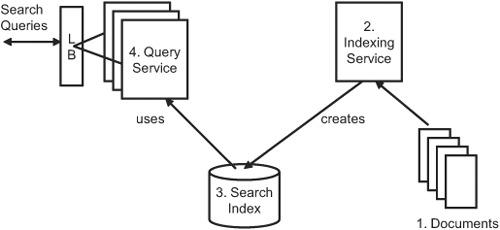
As shown in figure 11.1, there are four entities involved in adding search to your application: documents to be indexed, an asynchronous indexing service, the search index, and a synchronous query service.
There are two main services that you need to build to add search to your application. First is an asynchronous indexing service, which is responsible for creating asearch index—a reverse index of terms with related documents. Depending on the size of your documents, it may take a long time to create a full index, and this process is typically done offline or asynchronously. Once a search index has been created, this service may update the index, either through periodic polling for document changes or by being notified of changes through an event notification. The indexing service is responsible for keeping the search index created up-to-date.
Consider a typical application that uses user-generated comment (UGC). The UGC could be in many forms; for example, it could be questions and answers asked by users, images, articles or videos uploaded and shared by the user, or tagged bookmarks created by the user. In most applications, content can be classified into one or more categories. For example, one possible classification for this book’s content could be tagging, data collection, web crawling, machine learning, algorithms, search, and so on. Note that these classifications need not be mutually exclusive—content can belong to multiple categories. For most applications, it’s either too expensive or just not possible to manually classify all the content. Most applications like to provide a “narrow by” feature to the search results. For example, you may want to provide a general search feature and then allow the user to subfilter the results based on a subset of classification topics that she‘s interested in.