concept setting in category machine learning

This is an excerpt from Manning's book Collective Intelligence in Action.
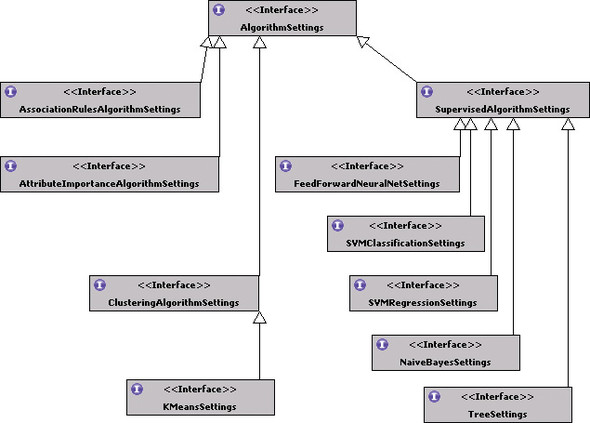
AlgorithmSettings, as shown in figure 7.18, is the common base class for specifying the settings associated with the various algorithms. A DME will typically use defaults for the settings and then use the specified settings to override the defaults.
Each specific kind of algorithm typically has its own interface to capture the settings. For example, KMeansSettings captures the settings associated with the k-means algorithm. This interface specifies settings such as the number of clusters, the maximum number of iterations, the distance function to be used, and the error tolerance range.
So far in this section, we’ve looked at the JDM objects for representing the dataset, the learning models, and the settings for the algorithms. Next, let’s look at the different kinds of tasks that are supported by the JDM.
For building a clustering model, there are two types of settings, as shown in figure 9.6. First are generic settings associated with the clustering process and represented by an instance of ClusteringSettings. Second are settings that are associated with a specific clustering algorithm. An example of such a setting is the KMeansSettings interface, which allows advanced users to specify the details of the k-means clustering algorithm.
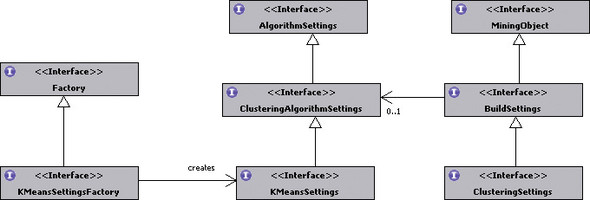
Next, an instance of KMeansSettings is created to specify settings specific to the k-means algorithm. Here, the distance function is set to be Euclidean. The maximum number of iterations and the minimum error tolerance are also specified: