concept square in category machine learning

This is an excerpt from Manning's book Grokking Machine Learning.
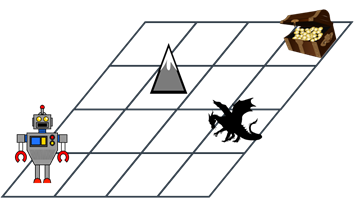
In Figure 2.10 we see a grid world with a robot on the bottom left corner. That is our agent. The goal is to get to the treasure chest in the top right of the grid. In the grid, we can also see a mountain, which means we cannot go through that square, since the robot cannot climb mountains. We also see a dragon, which will attack the robot, should the robot dare to land in the square of the dragon, so part of our goal is to not land over there. This is the game. And in order to give the robot information about how to proceed, we have a score. The score starts at zero. If we get to the treasure chest, then we gain 100 points. If we reach the dragon, we lose 50 points. And to make things fast, let’s say that for every step the robot makes, we lose 1 point, since the robot loses energy.
Figure 2.12. A grid world in which our agent is a robot. The goal of the robot is to find the treasure chest, while avoiding the dragon. The mountain represents a place in which the robot can’t pass through.
The way to train this algorithm, in very rough terms, is as follows. The robot starts walking around, recording its score, and remembering what steps took it to each decision. After some point, it may meet the dragon, losing many points. Therefore, it learns that the dragon square, and squares close to it, are associated to low scores. At some point it may also hit the treasure chest, and it starts associating that square, and squares close to it, to high scores. Eventually, the robot will have a good idea of how good each square is, and can take the path following the squares all the way to the chest. Figure 2.11 shows a possible path, although this one is not ideal, since it passes close to the dragon. Can you think of a better one?
Figure 4.26. The plot of our dataset. Triangles are happy aliens, and squares are sad aliens.
