concept sum in category machine learning

This is an excerpt from Manning's book Grokking Machine Learning.
By definition, a good linear regression model is one where the line passes by close to the points. What does close mean in this case? This is a subjective question, since a line that is close to some of the points may be far from others. In that case, do we rather find a line that is very close to some of the points and far from some of the others? Or do we try to find one that is somewhat close to all the points? The absolute error will help us make this decision. What we do is, for a line, we calculate the sum of vertical distances from each of the points to the line. That measure is precisely our absolute error, and it is illustrated in Figure 3.18. The error is calculated as the sum of the lengths of the red segments.
Again, our classifier will consist of a line that splits the happy and the sad faces. Many lines work, and you may think of some that are equally good or better than mine, but I’ll use the one I’ve drawn in Figure 4.5. This line consists of all the points where the sum of the horizontal coordinate (number of ‘crack’s) and the vertical coordinate (number of ‘dunk’s) is equal to 3.5. In other words, the equation of this line is:
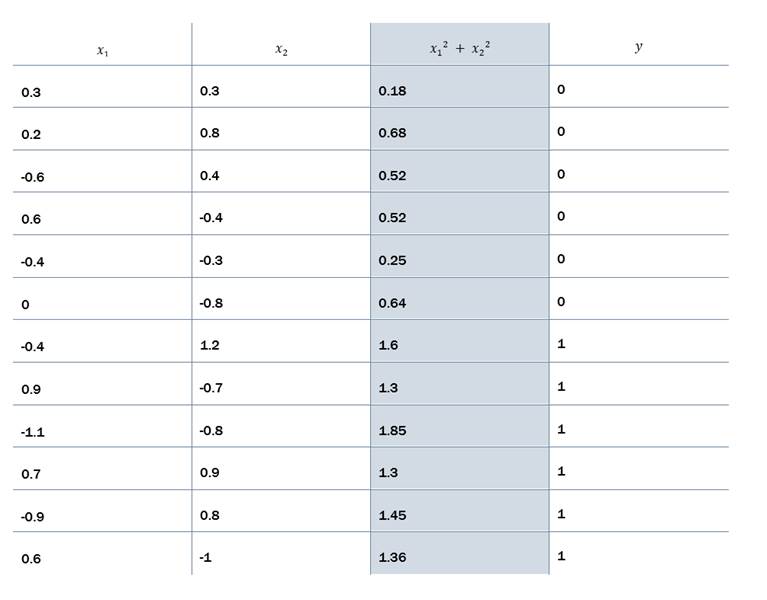
Table 9.2. We have added one more column to Table 9.1. This one consists of the sum of the squares of the values of the first two columns.

This is an excerpt from Manning's book Machine Learning with R, the tidyverse, and mlr.
Figure 10.5. Smoothing functions for continuous variables in GAMs are commonly the sum of a series of basis functions, which are often splines. Three spline basis functions are summed at each value of x to predict the value of y. The dotted line shows the sum of the three basis functions, which models the nonlinear relationship in the data.

The nonlinear functions learned by GAMs are often splines created from the sum of a series of basis functions.