concept term in category machine learning

This is an excerpt from Manning's book Machine Learning with TensorFlow, Second Edition.
Each one of those challenges is a grey box in the TensorFlow architecture meaning it is a component, has easy to use programming language APIs and plenty of documentation and support. And where something doesn’t make sense, that’s what we’re here for. I commit that all of the grey boxes will be addressed through the remaining part of the book. How’s that for customer service?
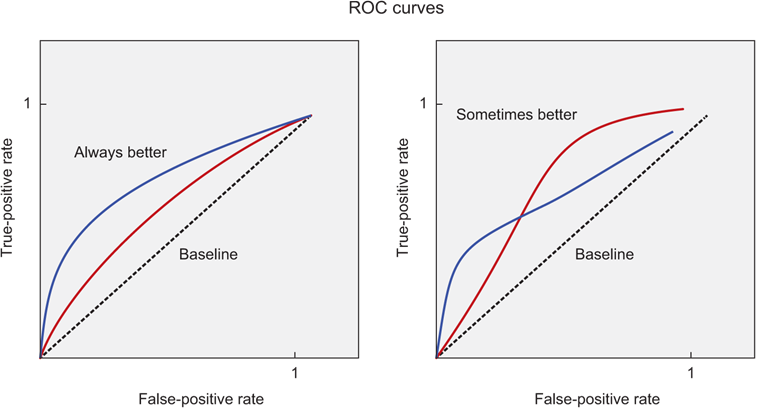
Figure 5.6 The principled way to compare algorithms is by examining their ROC curves. When the true-positive rate is greater than the false-positive rate in every situation, it’s straightforward to declare that one algorithm is dominant in terms of its performance. If the true-positive rate is less than the false-positive rate, the plot dips below the baseline shown by the dotted line.

This is an excerpt from Manning's book Machine Learning with TensorFlow.
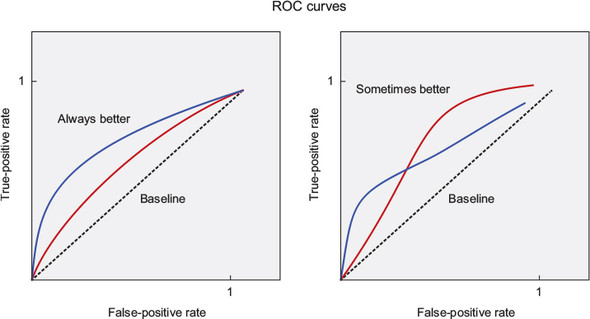
Figure 4.6. The principled way to compare algorithms is by examining their ROC curves. When the true-positive rate is greater than the false-positive rate in every situation, it’s straightforward to declare that one algorithm is dominant in terms of its performance. If the true-positive rate is less than the false-positive rate, the plot dips below the baseline shown by the dotted line.

This is an excerpt from Manning's book Mahout in Action.
This approach can give good results (0.69 on the GroupLens data set). At the moment, the major issue with the implementation is that it computes the SVD in memory. This requires the entire data set to fit in memory, and it’s precisely when this isn’t the case that this technique is appealing, because it can shrink the input without compromising output quality significantly. In the future, this algorithm will be reimplemented in terms of Hadoop, so the necessarily massive SVD computation can be distributed across multiple machines. It isn’t yet available at this stage of Mahout’s evolution.
Top Terms with -maxDFPercent=50
        comic                   =>    9.793121272867376
        comics                  =>    6.115341078151356
        con                     =>    5.015090566692931
        http                    =>    4.613376768249454
        i                       =>    4.255820257194115
        sdcc                    =>    3.927590843402978
        you                     =>    3.635386448917967
        rt                      =>   3.0831371437419546
        my                      =>   2.9564724853544524
        webcomics               =>    2.916910980686997

Top Terms with -maxDFPercent=20
        webcomics               =>   11.411304909842356
        comic                   =>   10.651778670719692
        comics                  =>   10.252182320186071
        webcomic                =>    7.813077817644392
        con                     =>    5.867863954816546
        http                    =>    4.937416185651506
        companymancomic         =>    4.899269049508231
        spudcomics              =>    4.543261228288923
        rt                      =>    4.149479137148176
        addanaccity             =>    4.056342724391392
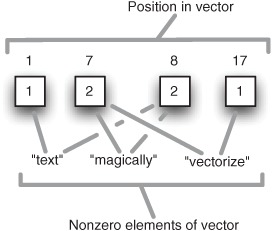
Figure 14.6. When the vector is size 20 instead of 100, collisions occur. The terms text and magically collide at location 8, and the terms magically and vectorize collide at location 7. These collisions make it more difficult to interpret the resulting vector, but typically they don’t affect classification accuracy.

This is an excerpt from Manning's book Collective Intelligence in Action.
In their first iteration, they launched an application where users—mainly friends and family—could buy items and view relevant articles. There wasn’t much in terms of personalization or user interaction or intelligence—a plain vanilla system.
Metadata can be generated by analyzing the interactions of users with items. User interactions provide valuable insight into preferences and interests. Some of the interactions are fairly explicit in terms of their intentions, such as purchasing an item, contributing content, rating an item, or voting. Other interactions are a lot more difficult to discern, such as a user clicking on an article and the system determining whether the user liked that item or not. This interaction can be used to build metadata about the user and the item. This metadata provides important information as to what kind of items the user would be interested in; which set of users would be interested in a new item, and so on.
This section deals with developing a representation for unstructured text by using the content of the text. Fortunately, we can leverage a lot of work that’s been done in the area of information retrieval. This section introduces you to terms and term vectors, used to represent metadata associated with text. Section 4.3 presents a detailed working example on this topic, while chapter 8 develops a toolkit that you can use in your application for representing unstructured text. Chapter 3 presents a collaborative-based approach for representing a document using user-tagging.
In its most basic form, a text document consists of terms—words that appear in the text. In our example, there are four terms: Collective, Intelligence, in, and Action. When terms are joined together, they form phrases. Collective Intelligence and Collective Intelligence in Action are two useful phrases in our document.
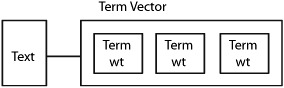
The Vector Space Model representation is one of the most commonly used methods for representing a document. As shown in figure 2.7, a document is represented by a term vector, which consists of terms appearing in the document and a relative weight for each of the terms. The term vector is one representation of metadata associated with an item. The weight associated with each term is a product of two computations: term frequency and inverse document frequency.
Term frequency (TF) is a count of how often a term appears. Words that appear often may be more relevant to the topic of interest. Given a particular domain, some words appear more often than others. For example, in a set of books about Java, the word Java will appear often. We have to be more discriminating to find items that have these less-common terms: Spring, Hibernate, and Intelligence. This is the motivation behind inverse document frequency (IDF). IDF aims to boost terms that are less frequent. Let the total number of documents of interest be n, and let ni be the number of times a given term appears across the documents. Then IDF for a term is computed as follows:
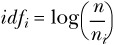
Note that if a term appears in all documents, then its IDF is log(1) which is 0.
Commonly occurring terms such as a, the, and in don’t add much value in representing the document. These are commonly known as stop words and are removed from the term vector. Terms are also converted to lowercase. Further, words are stemmed—brought to their root form—to handle plurals. For example, toy and toys will be stemmed to toi. The position of words, for example whether they appear in the title, keywords, abstract, or the body, can also influence the relative weights of the terms used to represent the document. Further, synonyms may be used to inject terms into the representation.