concept application group in category mesos

This is an excerpt from Manning's book Mesos in Action.
Table 7.1. Select Marathon API endpoints
API endpoint
Description
/v2/apps Query for all applications on a Marathon instance (GET) or create new applications (POST) /v2/apps/<app-id> Query for information about a specific app (GET), update the configuration of an app (PUT), or delete an app (DELETE) /v2/groups Query for all application groups on a Marathon instance (GET) or create a new application group (POST) /v2/groups/<group-id> Query for information about a specific application group (GET), update the configuration of an application group (PUT), or delete an application group (DELETE) /v2/info Query for information about the Marathon instance (GET) /v2/leader Query Marathon for the hostname and port of the current leader (GET), or cause the leader to abdicate and trigger a leader election (DELETE)
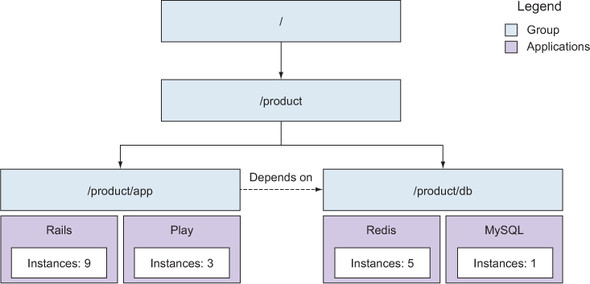
Marathon deployments are made up of standalone applications, or applications contained in application groups. Application groups can contain either applications or other application groups. Additionally, applications and application groups can have dependencies on other applications or application groups. Before delving too far into what application groups can look like, let’s consider the application groups, as shown in figure 7.8.
Using application groups, you can model complex applications—and their dependencies—all within a single JSON payload. This allows you to easily define dependencies, deploy updates, and scale entire application stacks running on Marathon, both by the individual application and by the entire application group. Now that you understand a bit more about how an application group is composed, let’s take a look at a more real-world scenario.