concept datacenter in category mesos

This is an excerpt from Manning's book Mesos in Action.
Traditionally, physical—and virtual—machines have been the typical units of computing in a datacenter. Machines are provisioned with various configuration management tools to later have applications deployed. These machines are usually organized into clusters providing individual services, and systems administrators oversee their day-to-day operations. Eventually, these clusters reach their maximum capacity, and more machines are brought online to handle the load.
In 2010, a project at the University of California, Berkeley, aimed to solve the scaling problem. The software project, now known as Apache Mesos, abstracts CPU, memory, and disk resources in a way that allows datacenters to function as if they were one large machine. Mesos creates a single underlying cluster to provide applications with the resources they need, without the overhead of virtual machines and operating systems. You can see a simplified example of this in figure 1.1.
Now consider solving the aforementioned scaling scenario by using Mesos, as shown in figure 1.6. You can see that you’d use these same machines in the datacenter to focus on running applications instead of virtual machines. The applications could run on any machine with available resources. If you need to scale, you add servers to the Mesos cluster, instead of adding machines to multiple clusters. If a single Mesos node goes offline, no particular impact occurs to any one service.
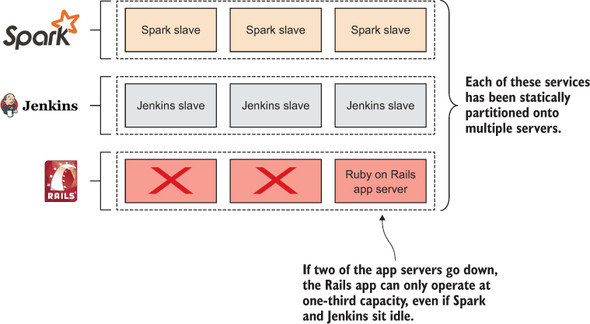
Mesos slaves can also be configured with certain attributes and resources, which allow them to be customized for a given environment. Attributes refer to key/value pairs that might contain information about the node’s location in a datacenter, and resources allow a particular slave’s advertised CPU, memory, and disk to be overridden with user-provided values, instead of Mesos automatically detecting the available resources on the slave. Consider the following example attributes and resources:
--attributes='datacenter:pdx1;rack:1-1;os:rhel7'
--resources='cpu:24;mem:24576;disk:409600'
I’ve configured this particular Mesos slave to advertise its datacenter; location within the datacenter; operating system; and user-provided CPU, memory, and disk resources. This information is especially useful when trying to ensure that applications stay online during scheduled maintenance. Using this information, a datacenter operator could take an entire rack (or an entire row!) of machines offline for scheduled maintenance without impacting users. Chapter 4 covers this (and more) in the Mesos slave configuration section.
Deploying applications within a datacenter has traditionally involved one or more physical (or virtual) servers. The introduction and mainstream adoption of virtualization has allowed us to run multiple virtual machines on a single physical server and make better use of physical resources. But running applications this way also means you’re usually running a full operating system on each of those virtual machines, which consumes resources and brings along its own maintenance overhead.