concept spark in category mesos

This is an excerpt from Manning's book Mesos in Action.
If you’re not familiar with Spark, don’t worry: the following sections use Spark as a demonstration of how Mesos distributes workloads and shares resources among multiple applications. I use Spark as an example to teach you about resource sharing and workload scheduling on a general-purpose Mesos cluster, and how Mesos compares to statically partitioned clusters within a datacenter. You’ll also get a brief introduction to the Mesos and Spark web interfaces, and, who knows, maybe you’ll even learn a thing or two about Spark in the process. Let’s get started.
To demonstrate how Spark connects to a Mesos cluster, accepts resource offers, launches executors, and executes tasks, I’ll demonstrate a simple job in Spark. The job will create a data set of integers between 1 and 100,000,000, and then use Spark to determine which integers in the set are prime numbers (numbers that are not equal to 1 and are divisible only by 1 and themselves).
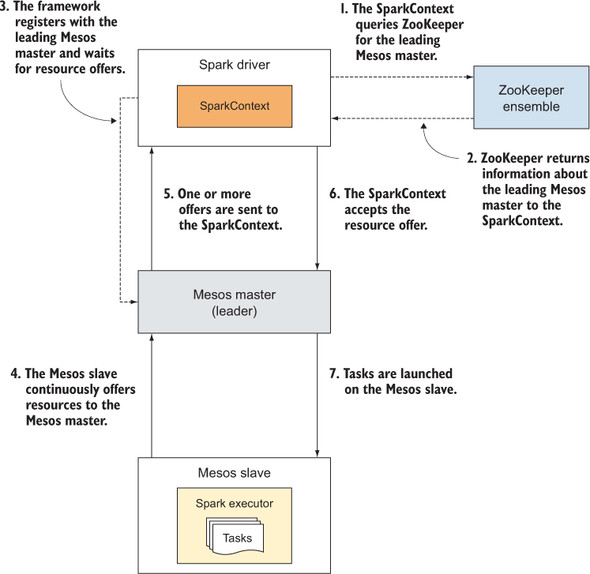
Instead of setting up a standalone Spark cluster for this job, Spark will use Mesos as a cluster manager for scheduling and distributing the individual tasks to available compute resources in the cluster. But before you get into running Spark on a Mesos cluster, let’s discuss the order of events that takes place when a framework interacts with a Mesos cluster. Figure 2.4 maps out Spark registering as a Mesos framework, accepting resource offers from the Mesos master, and finally, launching tasks on a Mesos slave.
Spark also provides APIs for several popular programming languages, including Python, Scala, and Java, and supports streaming workloads, interactive queries, and machine-learning libraries, in addition to MapReduce-like batch processing.