concept behavior in category microservice

This is an excerpt from Manning's book Testing Microservices with Mountebank.
Mountebank means a charlatan. It comes from Italian words meaning, literally, to mount a bench, which captures the behavior of snake oil salesmen who duped uninformed consumers into forking over money for quack medicine. It’s a useful word for describing what mountebank[4] the tool does, which is to conspire with your tests to dupe the system under test into believing that mountebank is a real runtime dependency.
Software engineers who hail from the object-oriented school of thought use the term decorate to mean intercepting a plain message and augmenting it in some way before forwarding it on to the recipient. It’s like what the postal service does when it applies a postmark to your letter after sorting it. The original letter you sent is still intact, but the postal workers have decorated it to postprocess it with a bit of dynamic information. In mountebank, behaviors represent a way of decorating responses before the imposter sends them over the wire.
Because of their flexibility and utility, behaviors also represent one of the most rapidly evolving parts of mountebank itself. We’ll look at all of the behaviors available as of this writing (representing v1.13), but expect more to come in the future.
Behaviors postprocess the responses before shipping them over the wire (figure 7.1). Although nothing prevents you from using behaviors with inject responses, most behaviors exist to allow you to reduce the amount of complexity inherent in using JavaScript to craft the response. Behaviors are a way of avoiding the complexity of inject responses in favor of simpler is responses, while still being able to provide appropriate dynamism to your response.
Behaviors sit alongside the type of response in the stub definition, as shown in listing 7.1. You can combine multiple behaviors together, but only one of each type. No behavior should depend on the order of execution of other behaviors. That is an implementation detail subject to change without notice.
Listing 7.1. Adding behaviors to a stub definition
{
  "responses": [{
    "is": { "statusCode": 500 },
    "_behaviors": {               #1
      "decorate": ...,            #2
      "wait": ...                 #3
    }                             #1
  }]
}
In this example, the is response will first merge the 500 status code into the default response, then it will pass the generated response object to both the decorate and wait behaviors. Each behavior will postprocess the response in a specific way, which we’ll look at shortly.

This is an excerpt from Manning's book Microservices in Action.
Most importantly, you need to know when a failure has occurred, and rather than one system, a microservice application depends on the interaction and behavior of multiple services, possibly built by different teams. At any point, your system should be transparent and observable to ensure that you both observe and diagnose problems.
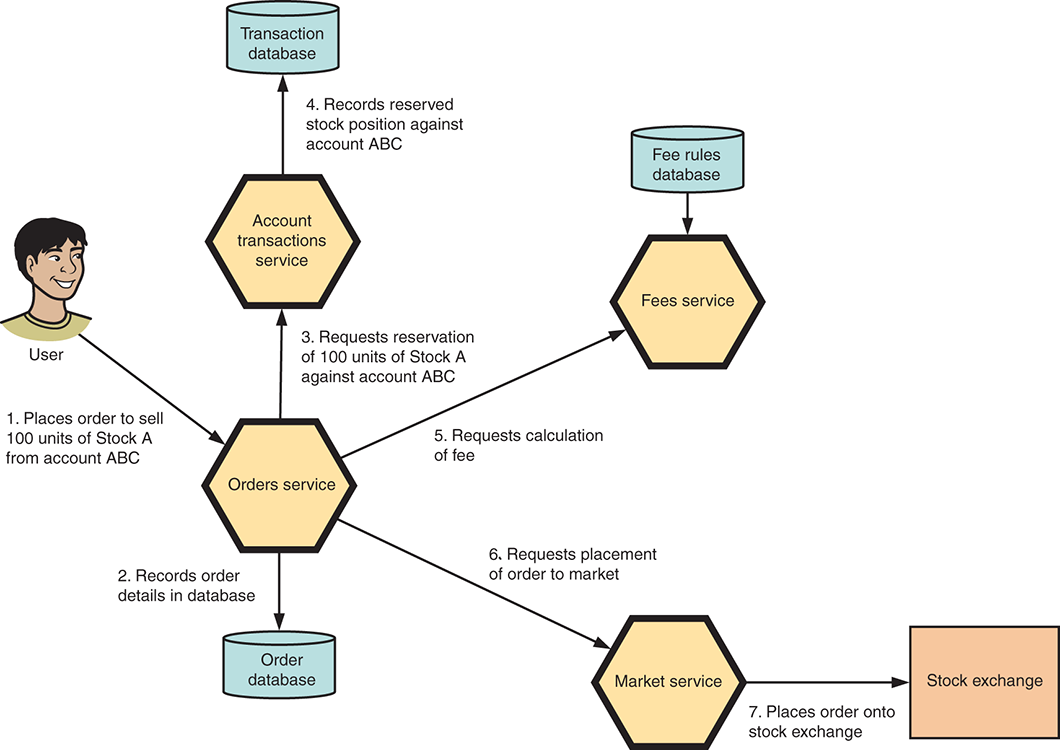
Figure 2.6 The orders service orchestrates the behavior of several other services to place an order to market.