concept engineer in category microservice

This is an excerpt from Manning's book Microservices in Action.
Over the course of this chapter, we’ll introduce the fictitious company of SimpleBank. They’re a company with big plans to change the world of investment, and you’re working for them as an engineer. The engineering team at SimpleBank wants to be able to deliver new features rapidly while ensuring scalability and stability — after all, they’re dealing with people’s money! Microservices might be exactly what they need.
This is easier said than done. Failures are inevitable in any complex system. An individual microservice might fail for a variety of reasons. Bugs can be introduced into code. Deployments can be unstable. Underlying infrastructure might let you down: resources might be saturated by load; underlying nodes might become unhealthy; even entire data centers can fail. As we discussed in chapter 5, you can’t even trust that the network between your services is reliable — believing otherwise is a well-known fallacy of distributed computing.1 Lastly, human error can lead to major failures. For example, I’m writing this chapter a week after an engineer’s mistake in running a maintenance script led to a severe outage in Amazon S3, affecting thousands of well-known websites.
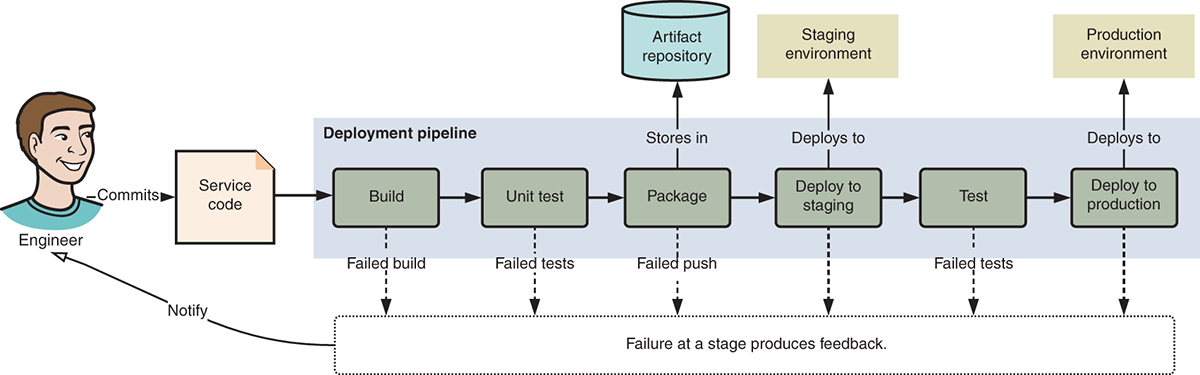
Figure 10.1 An example deployment pipeline builds, validates, and deploys a commit to production, providing feedback to engineers.