concept product page in category microservice

This is an excerpt from Manning's book The Tao of Microservices.
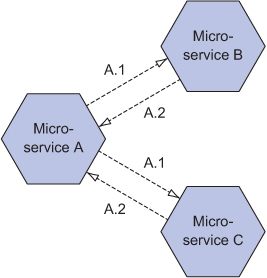
This is one of the more important microservice patterns (see figure 3.9). Instead of a deterministic, serial procedure for generating and collecting results, you announce your need and collect results as they come in. Let’s say you want to construct a product page for the e-commerce site. In the old world, you’d gather all the content from its providers and only return the page once everything was available. If one content provider failed, the whole page would fail, unless you’d written specific code to deal with this situation.
In the microservice world, individual microservices generate the content pieces and can’t affect others if they fail. You must construct the result (the product page) asynchronously, because your content components arrive asynchronously, so you build in fault tolerance by default. The product page can still display if certain elements aren’t ready—these can be injected as they become available. You get this flexibility as part of the basic architecture.
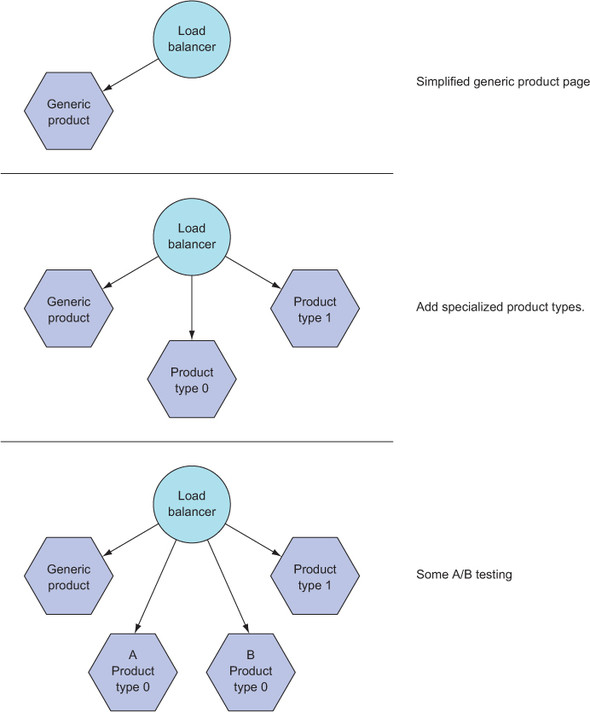
The e-commerce website has a page for each product. There’s a generic product page, but you also have special versions for certain product types: some products need more images, some have videos, and others include testimonials. In the legacy code base, these multiple versions have been implemented by extending the data structure that’s used to build the product page and using lots of conditional expressions on the product-page template. As the complexity of this approach became unmanageable over the years, two product types were given separate data structures and templates. You now have the worst of many worlds: increasing technical debt in the data structures and template logic, multiple versions to maintain, and shared code that needs to work with those multiple versions and that keeps breaking one or more of them when it changes.
You can use the strangler proxy to move product-page delivery to a new microservice (as shown in figure 7.2). At first, you’ll build only the generic case—and even then, only a simplified version. This microservice is vertical, in the sense that it handles the frontend and backend work needed to deliver a product page. Now is the time to reassess some of the features on the product page that have been added over the years and ask whether they’re truly necessary. If you’re lucky, you’ll find a set of products that can be presented with your simplified page, and you can go live quickly. Prerequisites to building this generic product-page microservice are production deployment of the strangler proxy, with sufficient routing logic in the proxy, and a messaging layer that provides product data the microservice can use.
Now, you can begin to add complexity. You can build the product page back up toward the full feature set of the monolith, but you have the opportunity to measure the impact of each feature. To add a feature, you add a new product-page microservice that extends the previous version with the new feature.[26] It’s critical that you also add capabilities to measure the effectiveness of that feature against the overall business goals. For example, if the goal is to increase conversions (purchases from the product page), then you can demonstrate whether the feature does that. Using the established principles of microservice deployment, such as Progressive Canary (discussed in chapter 5), allows you to simultaneously conduct A/B testing. You can compare the business-metric performance of the old version of the product page with your new version. Do this again and again, for each feature. You’ll build trust and support from marketing and product-management stakeholders as you do this, because you’re moving the needle for them. Once you start to demonstrate effective delivery of business value, it will become easier to have conversations about reducing the number and complexity of features, avoiding vanity features, and staying focused on the user. The numbers don’t lie.