concept project in category microservice

This is an excerpt from Manning's book Microservices in .NET Core, Second Edition.
Will the project survive long enough to recover the up-front investment in automation and distribution?
Listing 1.1. Startup with MVC
language="cs" linenumbering="unnumbered">namespace HelloMicroservices
{
  using Microsoft.AspNetCore.Builder;
  using Microsoft.AspNetCore.Hosting;
  using Microsoft.Extensions.DependencyInjection;

  public class Startup
  {
    public void ConfigureServices(IServiceCollection services)
    {
      services.AddControllers();        #1
    }

    public void Configure(
      IApplicationBuilder app,
      IWebHostEnvironment env)
    {
      app.UseHttpsRedirection();        #2
      app.UseRouting();
      app.UseEndpoints(endpoints =>
        endpoints.MapControllers());    #3
    }
  }
}
The is not much new to notice here, except that we are using the method
Createdto control the HTTP response. There are many such convenience methods on theControllerbase class, and throughout the book we will be using them to easily create the HTTP responses we want.

This is an excerpt from Manning's book Enterprise Java Microservices.
Digging deeper, you’ll see a handful of files sprinkled about the project:
Netflix has been a major proponent of the product-over-project idea for its microservices since rewriting its entire architecture under the leadership of Adrian Cockroft.
All these years, we’ve been developing projects and not products. Why? Because we develop an application that meets a set of requirements and then hand it over to operations. The application might require two weeks or two years to develop, but it’s still a project if, at the end, the application is handed over and the team disbanded. Some team members may be retained for a period to handle maintenance requests and enhancements, but the effort is still considered a project followed by lots of mini projects.
This is an excerpt from Manning's book Spring Microservices in Action.
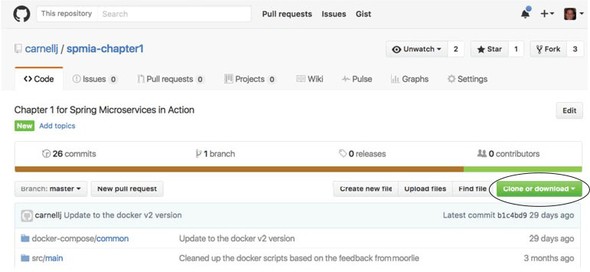
This example is by no means exhaustive or even illustrative of how you should build a production-level microservice, but it should cause you to take a pause because of how little code it took to write it. We’re not going to go through how to set up the project build files or the details of the code until chapter 2. If you’d like to see the Maven pom.xml file and the actual code, you can find it in the chapter 1 section of the downloadable code. All the source code for chapter 1 can be retrieved from the GitHub repository for the book at https://github.com/carnellj/spmia-chapter1.
If you’re a command-line user, you can install the git client and clone the project. For example, if you wanted to download chapter 1 from GitHub using the git client, you could open a command line and issue the following command:
This is an excerpt from Manning's book Microservices in .NET Core: with examples in Nancy.
Will the project survive long enough to recover the up-front investment in automation and distribution?
You can add Nancy to the project as a NuGet package by adding Nancy to the dependencies section in the project.json file that’s part of your empty application. You’ll also need the Microsoft.AspNetCore.Owin package, so go ahead and add that too. The dependencies section of project.json should look similar to the following listing.
Example 1.1. dependencies section of project.json
"dependencies": {
    "Microsoft.NETCore.App": {
      "version": "1.0.0",

      "type": "platform"
    },
    "Microsoft.AspNetCore.Server.IISIntegration": "1.0.0",
    "Microsoft.AspNetCore.Server.Kestrel": "1.0.0",
    "Microsoft.AspNetCore.Owin": "1.0.0",
    "Nancy": "2.0.0-barneyrubble"
  },
When you save the project.json file in Visual Studio, Visual Studio Code, or ATOM with OmniSharp, the IDE will perform a package restore, which means it will download any new NuGet packages specified in dependencies. Once the package restore is done, Nancy will be part of the project.
Now that you’ve added the Nancy NuGet package, you need to tell ASP.NET Core to use Nancy. You do so in the Startup.cs file, which is already part of the project. There’s already some code in Startup.cs; replace it with the code in the next listing, which first tells ASP.NET Core to use OWIN and then adds Nancy to the OWIN pipeline.