concept server in category microservice

This is an excerpt from Manning's book Microservices Security in Action.
The whole purpose of expecting servers to be immutable in a microservices deployment is to make deployment clean and simple. At any point, you can kill a running container and create a new one with the base configuration without worrying about runtime data. If the load on a microservice is getting high, for example, you need more server instances to scale horizontally. Because none of the running server instances maintains any runtime state, you can simply spin up a new container to share the load.
When you buy something from Amazon, for example, all your credit card information flows from your browser to Amazon’s servers over TLS, and no one in the middle can see what it is. When you log in to Facebook, your credentials flow from your browser to Facebook’s servers over TLS, and no one in the middle can intercept the communications and find out what those are.
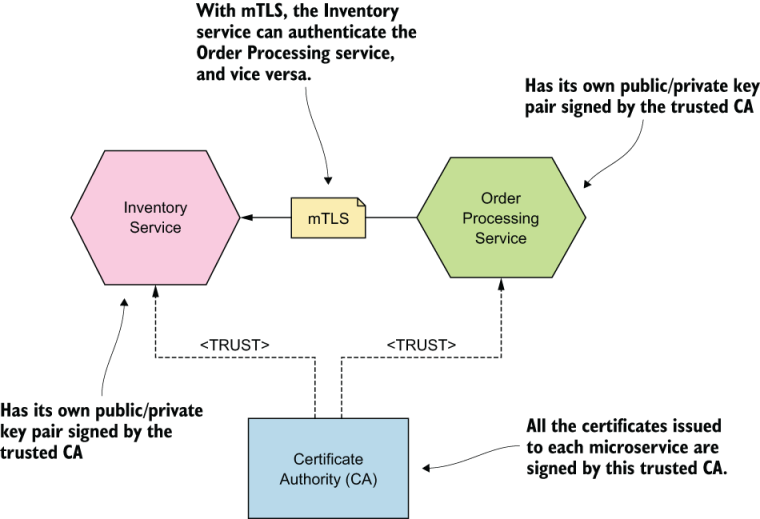
TLS itself is also known as one-way TLS, mostly because it helps the client identify the server it’s talking to, but not the other way around. Two-way TLS, or mutual TLS (mTLS), fills this gap by helping the client and the server identify themselves to each other. Just as the client knows which server it’s talking to in one-way TLS, with mTLS, the server knows the client it’s talking to as well (figure 6.2).
Figure 6.2 mTLS among microservices lets those services identify themselves. All the microservices in the deployment trust one CA.
Figure 6.1 The certificate of www.amazon.com, issued by the DigiCert Global CA. This certificate helps clients talking to www.amazon.com properly identify the server.

private void start() throws IOException {
server = NettyServerBuilder.forAddress(new InetSocketAddress(host, port))
        .addService(new InventoryImpl())                #1
        .sslContext(getSslContextBuilder().build())     #2
        .build()
        .start();

Runtime.getRuntime().addShutdownHook(new Thread() {
    @Override
    public void run() {
          System.err.println("Shutting down gRPC server since JVM is shutting down");
        InventoryServer.this.stop();
        System.err.println("*** server shut down");
    }
});
}

This is an excerpt from Manning's book Spring Microservices in Action.
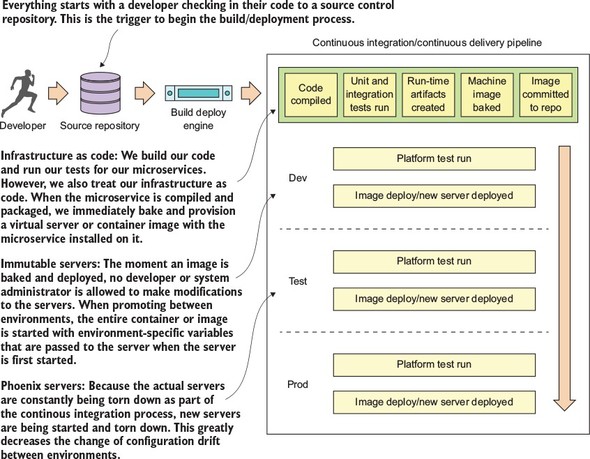
One of the core parts of a microservice architecture is that each instance of a microservice should be identical to all its other instances. You can’t allow “configuration drift” (something changes on a server after it’s been deployed) to occur, because this can introduce instability in your applications.
“I made only one small change on the stage server, but I forgot to make the change in production.” The resolution of many down systems when I’ve worked on critical situations teams over the years has often started with those words from a developer or system administrator. Engineers (and most people in general) operate with good intentions. They don’t go to work to make mistakes or bring down systems. Instead they’re doing the best they can, but they get busy or distracted. They tweak something on a server, fully intending to go back and do it in all the environments.
Second, the Phoenix server pattern helps to improve resiliency by helping find situations where a server or service isn’t cleanly recoverable after it has been killed and restarted. Remember, in a microservice architecture your services should be stateless and the death of a server should be a minor blip. Randomly killing and restarting servers quickly exposes situations where you have state in your services or infrastructure. It’s better to find these situations and dependencies early in your deployment pipeline, rather than when you’re on the phone with an angry company.
The organization where I work uses Netflix’s Chaos Monkey (https://github.com/-Netflix/SimianArmy/wiki/Chaos-Monkey) to randomly select and kill servers. Chaos Monkey is an invaluable tool for testing the immutability and recoverability of your microservice environment. Chaos Monkey randomly selects server instances in your environment and kills them. The idea with using Chaos Monkey is that you’re looking for services that can’t recover from the loss of a server, and when a new server is started, it will behave in the same fashion as the server that was killed.