concept service instance in category microservice

This is an excerpt from Manning's book Spring Microservices in Action.
The advantage of cloud-based microservices centers around the concept of elasticity. Cloud service providers allow you to quickly spin up new virtual machines and containers in a matter of minutes. If your capacity needs for your services drop, you can spin down virtual servers without incurring any additional costs. Using a cloud provider to deploy your microservices gives you significantly more horizontal scalability (adding more servers and service instances) for your applications. Server elasticity also means that your applications can be more resilient. If one of your microservices is having problems and is falling over, spinning up new service instances can you keep your application alive long enough for your development team to gracefully resolve the issue.
Fault-tolerant— Service discovery needs to detect when a service instance isn’t healthy and remove the instance from the list of available services that can take client requests. It should detect these faults with services and take action without human intervention.
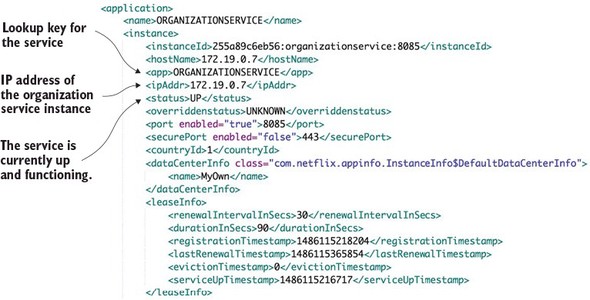
I’m walking through the DiscoveryClient to be completed in our discussion of building service consumers with Ribbon. The reality is that you should only use the DiscoveryClient directly when your service needs to query Ribbon to understand what services and service instances are registered with it. There are several problems with this code including the following:
You aren’t taking advantage of Ribbon’s client side load-balancing—By calling the DiscoveryClient directly, you get back a list of services, but it becomes your responsibility to choose which service instances returned you’re going to invoke.