concept set in category microservice

This is an excerpt from Manning's book Microservices Security in Action.
Aggregating a set of logs can produce metrics. In a way, metrics reflect the state of the system. In terms of security, the average invalid access requests per hour is a metric, for example. A high number probably indicates that the system is under attack or the first-level defense is weak. You can configure alerts based on metrics. If the number of invalid access attempts for a given microservice goes beyond a preset threshold value, the system can trigger an alert.
In chapter 6, we discussed securing service-to-service communications in a microservices deployment with mTLS. mTLS is, in fact, the most popular option for authenticating one microservice to another. JSON Web Token (JWT), which provides a way to carry a set of claims or attributes from one party to another in a cryptographically secure way, also plays a key role in securing service-to-service communications in a microservices deployment.

This is an excerpt from Manning's book The Tao of Microservices.
You can use microservices to do the sharding by adding a shard property to the timeline:* messages. Run new instances of the timeline service, one group for each shard, that react only to messages containing the shard property. At this point, you have the old timeline service running against the old database, and a set of new sharding timeline services. The implementation of both types of timeline is the same; you’re just changing the deployment configuration and pointing some instances at new databases.
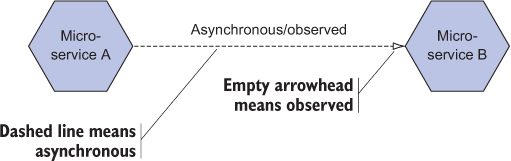
Figure 3.5. Fire-and-forget pattern: the general form of this interaction involves a set of different microservices observing an emitted message. The shopping-cart service emits a checkout message, and various other services react to it: delivery, checkout-email, and perhaps audit. This is a common pattern.
The heat from the core (all the stuff inside the containment vessel, including the rods) is extracted using water. This coolant water is radioactive, so you can’t use it directly to drive the turbine. You have to use a heat exchanger to transfer the heat to a set of completely separate water pipes; that water, which isn’t radioactive, drives the turbine. You have a primary coolant system with radioactive water and a secondary coolant system with “normal” water. Everything is under high pressure and at a high temperature, including the turbine, which is cooled by the secondary system. The secondary water must be very pure and contain almost no microscopic particles, to protect the turbine blades, which are precision engineered. Observe how complexity lives in the details: a simple fact—that water drives the turbine—hides the complexity that it must be “special” purified water. Time for a high-level diagram: see figure 5.1.
Each developer should provide a set of mock messages for their service. Where do these mock messages live? At one extreme, you can place all mock-message flows in a common mocking service. All developers commit code to this service, but conflicts are rare because work isn’t likely to overlap. At the other extreme, you can provide a mock service along with each service implementation. The mock service is an extremely simple service that returns hardcoded responses.
The practical solution for most teams is somewhere in the middle. Start with a single universal mocking service, and apply the Split pattern whenever it becomes too unwieldy. Sets of services with a common focus will tend to get their own mocking service. The development environment is typically a small set of actual services, along with one or two mocking services. This minimizes the number of service processes needed on a developer machine.