concept association in category .net

This is an excerpt from Manning's book Entity Framework 4 in Action.
When talking about associations, the biggest mismatch between the relational and object worlds is how relationships are maintained. Database tables are related using a mechanism that is different from the one used by classes. Let’s examine how the cardinality of relationships is handled in both worlds.
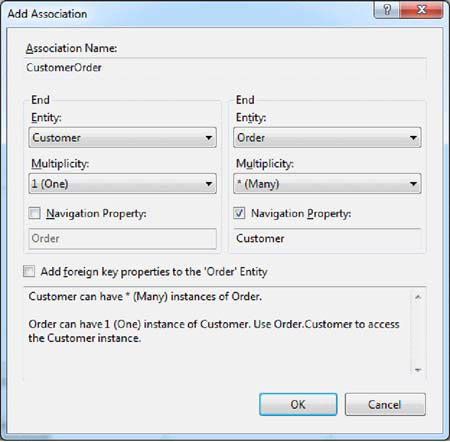
So far, you’ve learned that associations are important not only for model expressiveness, but even for Entity Framework, which uses them to simplify searches through LINQ to Entities. It’s not surprising that associations can participate in the projection mechanism too. There are almost no differences between projecting an association collection or a single association. In both cases, the syntax is similar to what you have seen already.
Listing 5.13. Declaring and defining associations
<EntityContainer ...> <AssociationSet Name="OrderOrderDetail" Association="OrderITModel.OrderOrderDetail"> <End Role="Order" EntitySet="Orders"> <OnDelete Action="Cascade" /> </End> <End Role="OrderDetail" EntitySet="OrderDetails" /> </AssociationSet> </EntityContainer> <Association Name="OrderOrderDetail"> <End Role="Order" Type="OrderITModel.Order" Multiplicity="1" /> <End Role="OrderDetail" Type="OrderITModel.OrderDetail" Multiplicity="*" /> </Association>

This is an excerpt from Manning's book NHibernate in Action.
In an object model, associations represent the relationships between objects. For instance, a bid has a relationship with an item. This association is created using object references. In the relational world, an association is represented by a foreign key column, with copies of key values in several tables. There are subtle differences between the two representations.
Object references are inherently directional: the association is from one object to the other. If an association between objects should be navigable in both directions, you must define the association twice, once in each of the associated classes.
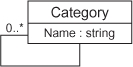
You use properties to express associations between POCO classes, and you use accessor methods to navigate the object graph at runtime. Let’s consider the associations defined by the Category class. The first association is shown in figure 3.3.
NHibernate doesn’t “manage” persistent associations. If you want to manipulate an association, you must write exactly the same code you would write without NHibernate. If an association is bidirectional, both sides of the relationship must be considered. Anyway, this is required if you want to use your objects without NHibernate (for testing or with the UI).
Without the inverse attribute, NHibernate would try to execute two different SQL statements, both updating the same foreign-key column, when you manipulate the association between the two instances. By specifying inverse="true", you explicitly tell NHibernate which end of the association it should synchronize with the database. In this example, you tell NHibernate that it should propagate changes made at the Bid end of the association to the database, ignoring changes made only to the bids collection. If you only call item.Bids.Add(bid), no changes are made persistent. This is consistent with the behavior in .NET without NHibernate: if an association is bidirectional, you have to create the link on two sides, not just one.