concept EAM in category .net

This is an excerpt from Manning's book Dependency Injection in .NET.
Figure 1.12. The Hello DI application from section 1.2 contains a SEAM between the Salutation and ConsoleMessageWriter classes because the Salutation class only writes through the ABSTRACTION of the IMessageWriter interface.
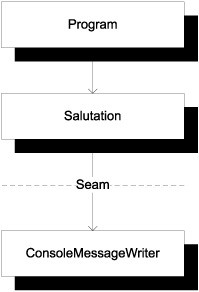
Everywhere we decide to program against an interface instead of a concrete type, we introduce a SEAM into the application. A SEAM is a place where an application is assembled from its constituent parts,[13] similar to the way a piece of clothing is sewn together at its seams. It’s also a place where we can disassemble the application and work with the modules in isolation.
WCF has lots of extensibility points, but when it comes to DI we only need to know about the IInstanceProvider interface and contract behaviors. A contract behavior is a SEAM in WCF that allows us to modify how a given contract (that is, a service) behaves.
WPF data binding requires us to assign the DEPENDENCY (the ViewModel) to the DataContext property. This is, in my opinion, misuse of PROPERTY INJECTION because it signals that the DEPENDENCY is optional, which it isn’t. However, WPF 4 introduces something called a XamlSchemaContext, which can be used as a SEAM that gives us greater flexibility when it comes to instantiating Views based on markup.[9]